
Filmography
Feature Films
1962
barravento
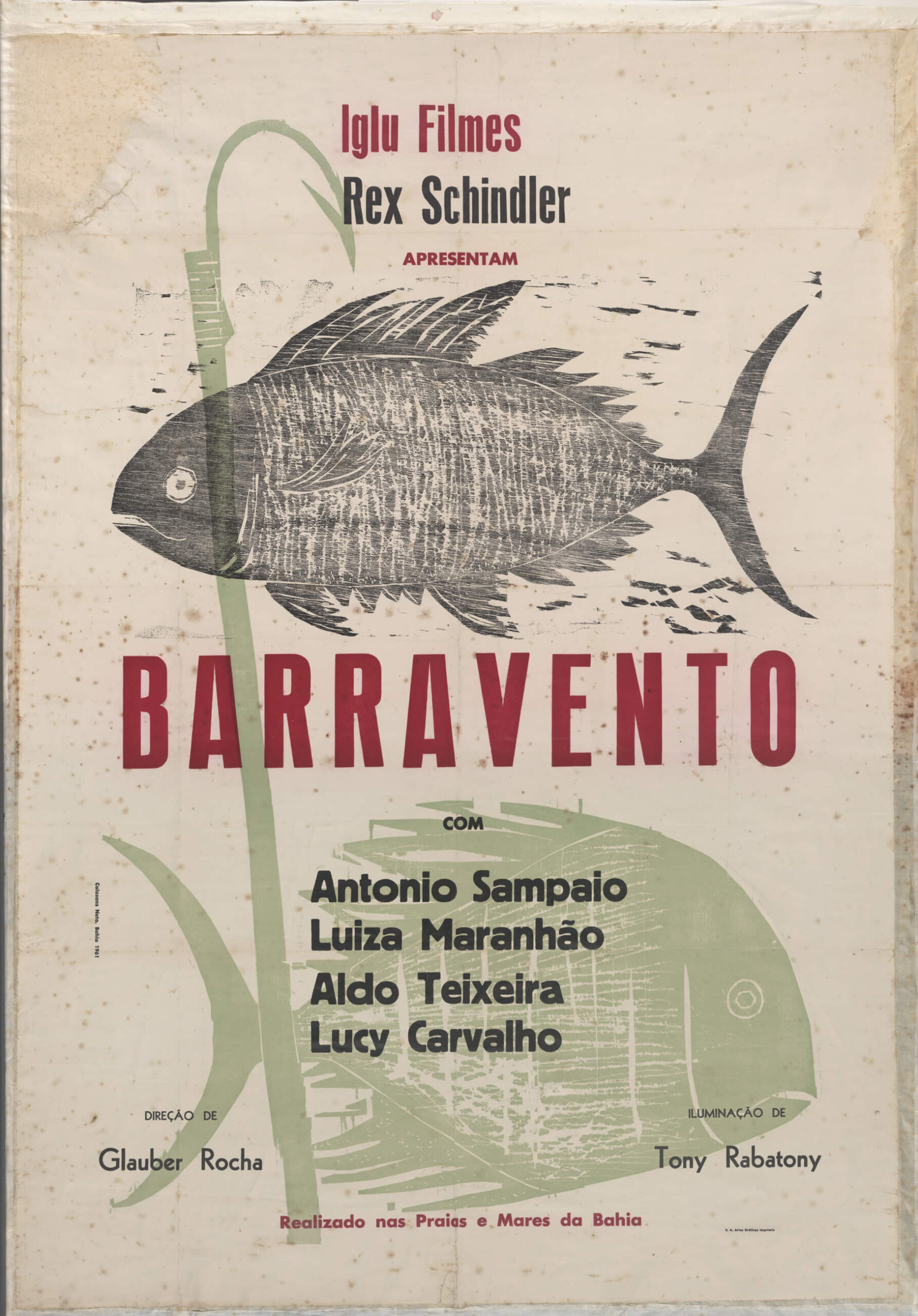
In a fishing village where the fishermen’s ancestors came from Africa as slaves, ancient mystical cults linked to Candomblé persist. The arrival of Firmino, a former resident who moved to Salvador fleeing poverty, changes the peaceful landscape of the place, polarizing tensions. Firmino is attracted to Cota, but cannot forget Naína, who, in turn, is fond of Aruã. Firmino orders a spell against Aruã, which is not affected, unlike the village, which sees its net broken, preventing fishing. Firmino incites the fishermen to revolt against the owner of the net, even destroying it. Police arrive in the village to control the equipment. In his fight against exploitation, Firmino clashes with the Master, the intermediary between the fishermen and the owner of the net. A fisherman convinces Aruã to fish without the net, since his chastity would make him protected by Iemanjá. The fishermen are successful in their endeavor, with Aruã’s leadership standing out. Naína reveals her impossible love for Aruã to an old black woman. Faced with his defeat against mysticism, Firmino convinces Cota to take Aruã’s virginity, thus breaking the religious enchantment that supposedly invested him with Iemanjá. Aruã succumbs to temptation. A storm heralds the “barravento,” the moment of violence. The fishermen go out to sea, resulting in the death of two of them, Vicente and Chico. Firmino denounces Aruã’s loss of chastity. The Master denies it. The dead are mourned, and Naína agrees to undergo the initiation rites so that she can marry Aruã. He promises marriage, but first decides to leave for the city to work and earn money to buy a new net. In the same place where Firmino arrived in the village, Aruã departs towards the city.
1964
Deus e o Diabo na Terra do Sol
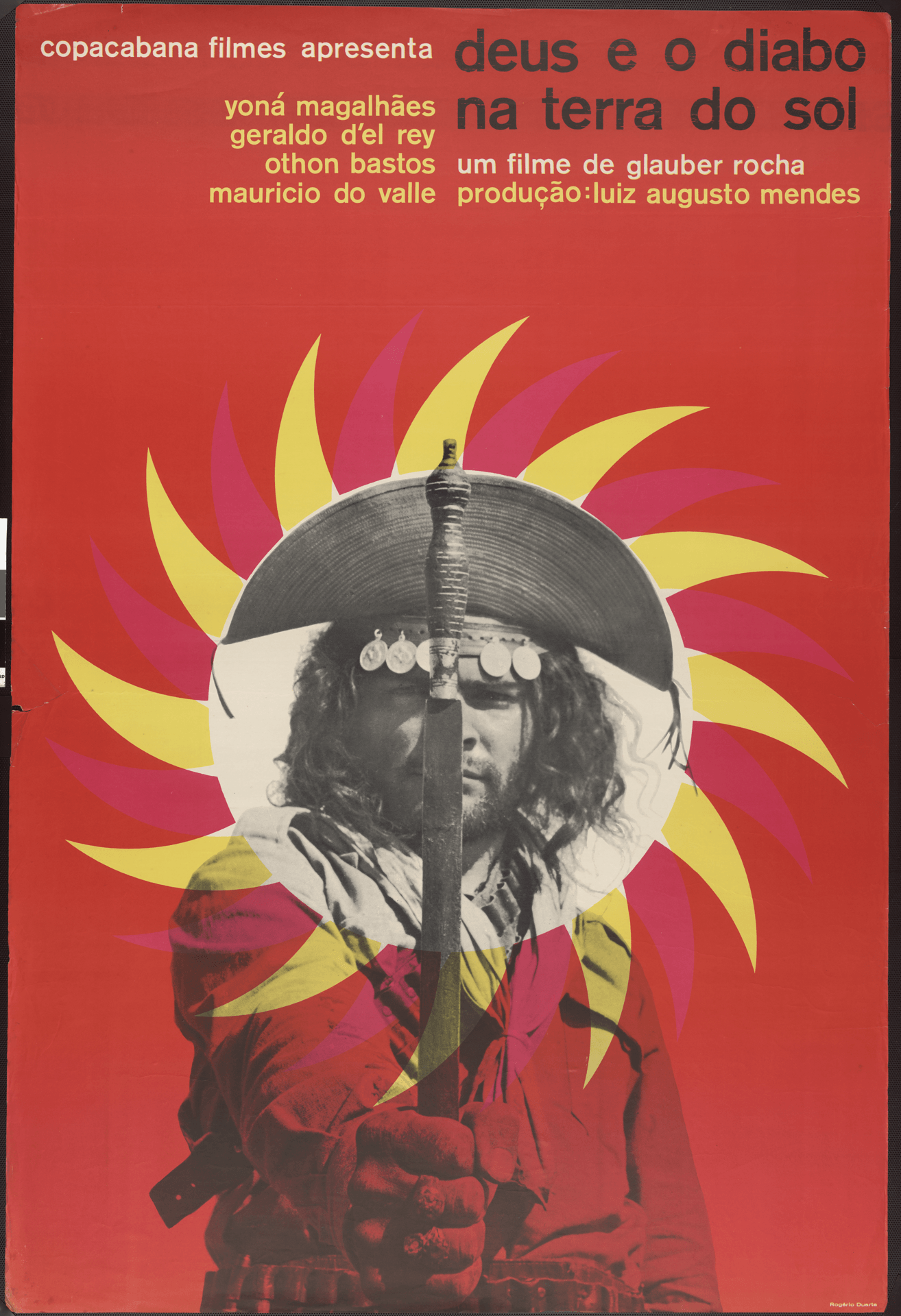
Manuel and Rosa subsist in the northeastern backlands of Brazil by working for a colonel. On the day of the cattle division between Manuel and the colonel, the two argue, and Manuel avenges the colonel’s injustice with blood. Pursued, Manuel kills two of the colonel’s henchmen, but one of them kills his mother. With no more roots in his mother’s house, Manuel decides to follow the holy man Sebastião and his followers. Rosa, always skeptical of Sebastião’s power, tries to persuade her husband to abandon his holy life. But Manuel dedicates himself ardently to the holy man, sharing with him the sacrifice of a child, when Rosa, in despair, murders the holy man while Antônio das Mortes destroys all of Sebastião’s followers. Manuel and Rosa, once again, surrender to the fate of the backlands, until they encounter Corisco, the blond devil. He accepts Manuel into his gang and renames him Satan. With his new name, Manuel plunders and destroys farms, gaining fame throughout the backlands through the songs of blind Júlio. Once again, Antônio das Mortes enters the scene to start the ‘great war’, killing Corisco and his gang, so that Manuel and Rosa can head towards the sea of redemption.
1967
terra em transe

The journalist and poet Paulo Martins oscillates between various political forces vying for power in the fictional country of Eldorado: D. Porfírio Diaz, a right-wing leader and politician of tradition; D. Felipe Vieira, governor of the Province of Alecrim, a populist and demagogic leader; and D. Julio Fuentes, a powerful businessman who owns a media empire. In a conversation with the activist Sara, Paulo concludes that the people of Eldorado need a leader and that Vieira possesses such attributes. Eldorado finds itself caught between a coup d’état and populism, between crisis and transformation. And Paulo, torn between poetry and politics, agonizes, unable to resolve the inconsistencies of Eldorado and his own contradictions.
1967
câncer
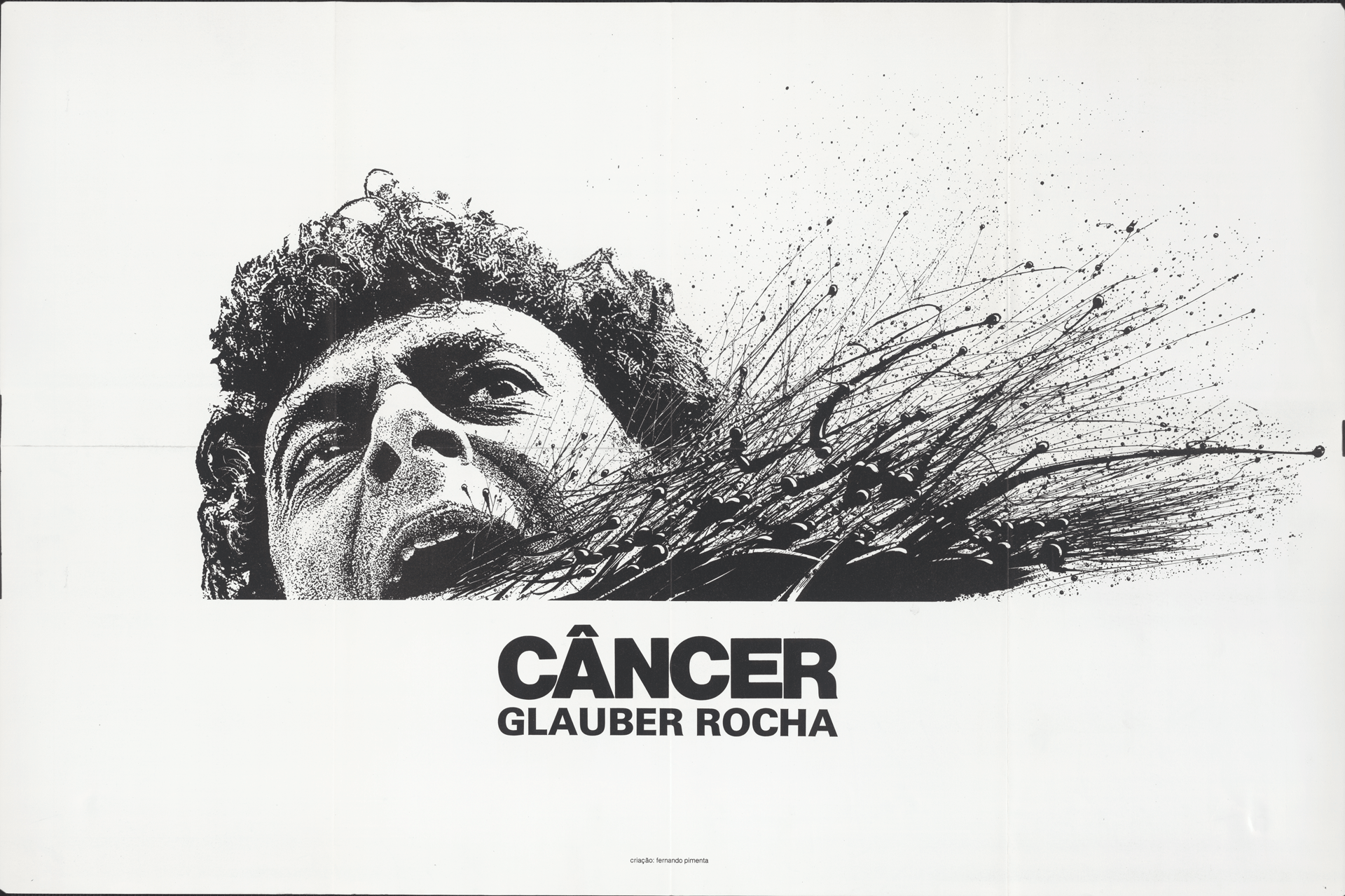
In Rio de Janeiro, in 1968, amidst the political turmoil of the time, a typical black Carioca rogue encounters the receiver of his petty crimes. Between them, a sensual blonde moves in a slippery manner, alternately contemplating one and then the other with her caresses. Beneath this relatively prosaic structure, *Câncer* paints a picture of that Brazilian moment, capturing with a nervous camera details of a Rio that no longer exists and where the old Cinelândia appears, almost as a character in the film. The film was shot in an improvisational style over four days in Rio de Janeiro in 1968, but finalized in Cuba and Italy in 1972. It follows three characters, played by Hugo Carvana, Antônio Pitanga, and Odete Lara, involved in situations of latent violence, incited by issues of race, class, and sex. *Câncer* is Glauber Rocha’s first experiment with direct sound in his films.
1968
O Dragão da Maldade Contra o Santo Guerreiro
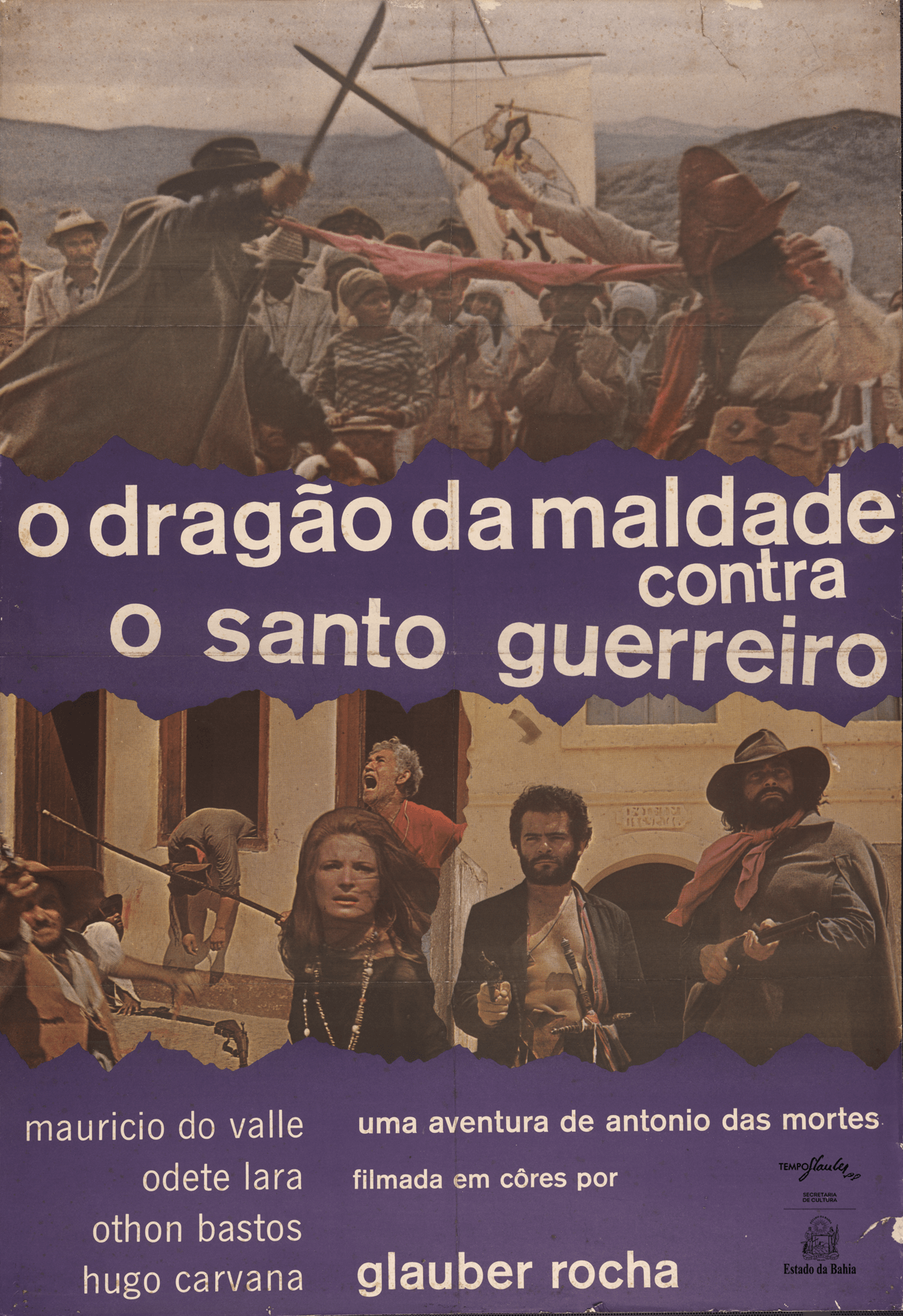
Coirana and a group of bandits invade Jardim das Piranhas, threatening to unleash chaos. Despite Colonel Horácio’s opposition, Matos hires Antônio das Mortes to exterminate the gang. In Jardim das Piranhas, the atmosphere is tense, fueled by the Colonel’s delusions of grandeur, the delegate’s political ambitions, the professor’s disillusionment, Laura’s sad loneliness, and the priest’s mystical crisis. After dueling with and defeating Coirana, Antônio das Mortes receives a revelation from the Saint and begins to act according to his concepts of morality and justice. Joining forces with the Professor, he eliminates Mata Vaca’s gunmen, hired by Colonel Horácio. Dragão da Maldade contra O Santo Guerreiro is filmed with direct sound.
1970
Der Leone Have Sept Cabezas
A preacher walks through African lands. A tribe holds a ceremony to mourn the body of a black man. One of the members, Zumbi, is revered by the others. He speaks about slavery and the exploitation of black people by whites. An armed man, Pablo, walks among black demonstrators who advocate for the end of colonization. Among them is also a group of whites. This group includes an American agent, a woman, Marlene, and two men. Pablo speaks in favor of resistance and is attacked by the preacher, who imprisons him and hands him over to the group of whites. He is punished. Some black people gathered discuss the possibility of carrying out an armed revolution. The group of whites negotiates an agreement with Xobu, the representative of the local people, aimed at ending colonialism. The representative is appointed president and speaks about the country’s progress, celebrating alongside the population. The whites break the agreement and execute a group of black people. Xobu is betrayed. Zumbi frees Pablo, and the two join the resistance militia to seize power from the dominant group. Under the watchful eyes of the local population, the preacher punishes Marlene. The others are exposed to the crowd amidst the celebration and suffer retaliation. Alongside Zumbi and Pablo, the people dance and celebrate. Together with the militiamen, the two walk through the forest.
1970
cabeças Cortadas
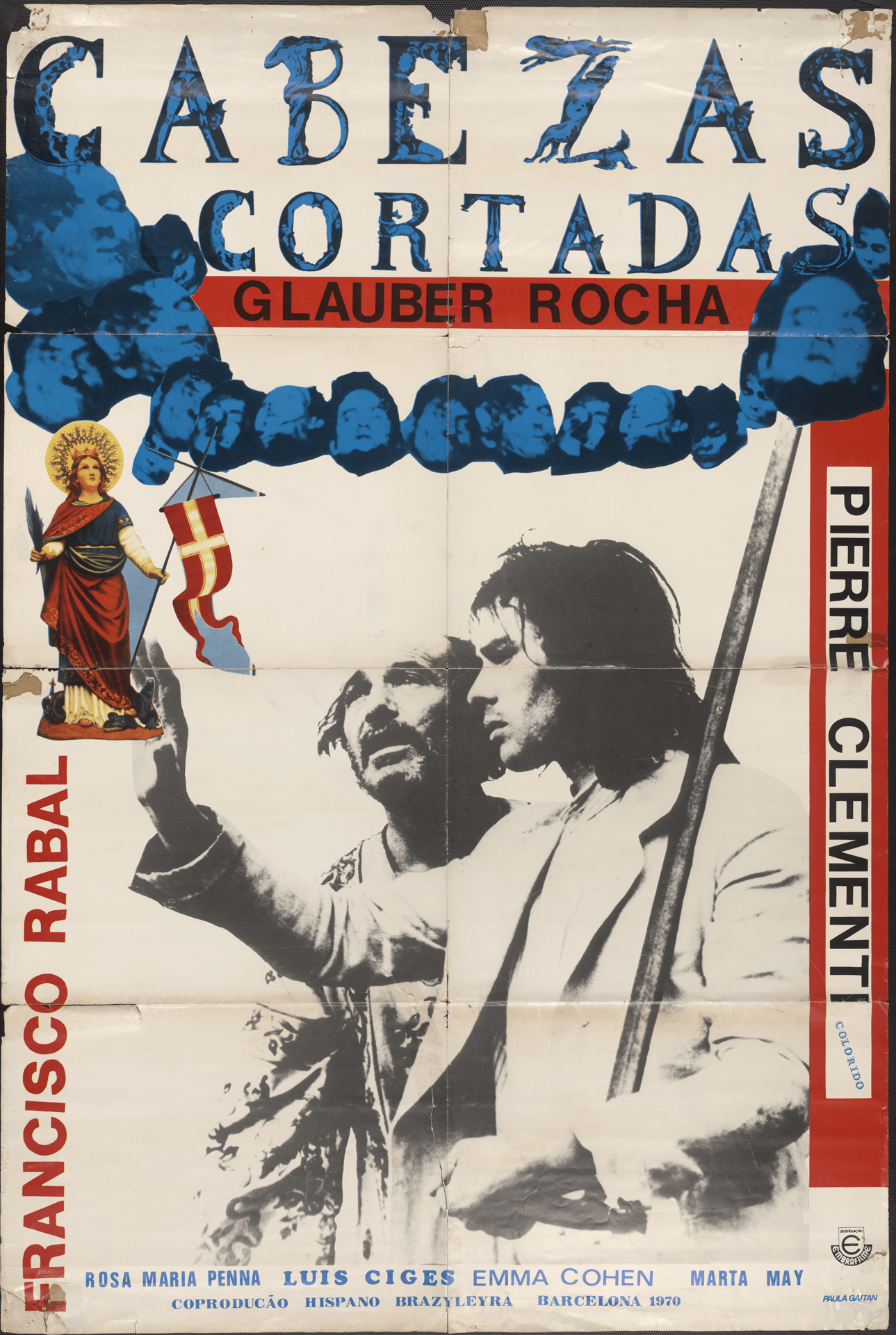
Diaz is a delusional despot who lives secluded in his castle, dreaming of omnipotence. Outside the castle, a shepherd performs miracles and leads the people.
1973
história do brasil
This montage film was made during Glauber Rocha’s exile from 1971 to 1973 between Cuba and Rome, and finished in Paris in 1974. After filming “The Lion of Seven Heads” and declaring himself a “tri-continental” filmmaker, Glauber joined the Cuban leader Marcos Medeiros, who was returning from the 1968 guerrilla war, to create a political inventory of Latin America. In voice-over at one point, Glauber engages in dialogue with Medeiros, for example, about the profiles of the military presidents who succeeded one another in power.
It is considered a “semi-finished” work by Glauber that has a certain pedagogical character and seeks, through dialectical montage, to offer a critical review of colonization, class struggle, messianism, and the establishment of populist governments in the Third World. There is a chronology to the presented facts which, supported by extensive iconography (films, engravings, photos, etc.), nevertheless operate through “free” associations that allow the viewer a “polyphonic” vision of the “History of Brazil”.
Narrated by Jirges Ristum, the documentary uses various images from the ICAIC (Cuban Institute of International Cooperation) archives showing Fidel Castro and Che Guevara during the Revolution, as well as scenes from Brazilian films such as “São Paulo S/A” and “Assalto ao Trem Pagador” (The Pay Train Robbery), and documentary footage of the 1964 coup in Brazil punctuated by Tropicalia songs. “History of Brazil” was censored in the country from its inception, only being released for exhibition in 1985.
1975
claro
A woman walks through the city of Rome. She sings, shouts, and gives speeches under the watchful eyes of people passing through the city’s streets, parks, and squares. She and Glauber Rocha converse near a large building. The same woman engages with a series of characteristic types, such as a transvestite with whom she converses at length, or the brothers Mario and Carlo, sons of a self-confessed capitalist, and even participates in some anti-fascist demonstrations, moving among the protesters. Mario and Carlo discuss the possibility of killing their father to inherit his money, while the American Manson, locked in a room, reveals to his friend Yvonne all his bitterness regarding memories of the Vietnam War. Near a poor area of the city, the woman, accompanied by Glauber, walks between houses. Their presence causes a stir. They converse and argue with local residents. Seated in a rocking chair, he sings and talks on the phone while listening to some Brazilian music. Images of paintings, news from Italian newspapers, magazine covers, and people blend together to the sound of the music.
1980
a idade da terra
Freely structuring political and social denunciation, with passages of an openly didactic or pamphleteering nature, allusions emerge to the life and mission of Christ, who appears sometimes as a worker, sometimes as a character in Candomblé. The characters are metaphors for a political situation or archetypes of behavior: a mystical marginal fisherman, a black prophet, the Portuguese conqueror, the middle-class subversive, imperialist forces, indigenous nations, the strength of the Amazons, the modern woman, and others. It is the very perplexity of the Third World, in an attempt to synthesize Western economic history, with appeals to revolution, universal understanding, peace, and a democracy that is neither capitalist nor socialist.
Documentaries and Short Films
1959
cruz na praça
The film depicts a scene of attraction between two young men inside a church. Both were praying, and at a certain moment, one of the young men, excited by both the prayer and the other’s physique, lunges at him, tearing off his member with his hand. The castrated man (represented by Luís Carlos Maciel) begins to chase the castrator around the cross in the square. “Cruz na Praça” (Cross in the Square) shows the eroticism and frustrated desire of a man conflicted by his homosexuality. Heir to the Catholic tradition, the young man dances through the church before the baroque angels and the cross. The mutilation of repressed desire is compared to the naive eroticism of the angels’ nudity. Glauber Rocha announces the sacred, profane meaning of religious ornament, assimilated to the erotic, wild, and resentful behavior of the young man. He shows the image of the cross reconciled with the profane meaning of that desire; sex is dramatized as liberation and challenge.
1959
pátio
On a terrace tiled in a checkerboard pattern, a boy and a girl lie sprawled across a patio. The couple creates a play of shapes. Their movements unfold slowly: they touch, roll on the ground, move closer and further apart.
1965
Amazonas, amazonas
Glauber Rocha’s first color film, shot between Deus e o Diabo na Terra do Sol and Terra em Transe. It was commissioned to be a classic documentary about the natural beauty and richness of the Amazon region, but it still retains Glauberian characteristics, such as the lyrical rapture of the shots and the director’s nationalist concerns, revealed in the presence of people at work, urban sequences, producers, and merchandise.
1966
maranhão 66
Inauguration of José Sarney, governor of the state of Maranhão. The elected politician’s speech is juxtaposed with images of social ills and other chronic problems in the northeastern state: starving people without assistance, miserable homes, and helpless sick people.
1968
1968
The March of the 100,000 was one of the most important events in the fight against the military dictatorship. On June 26, 1968, approximately one hundred thousand people took to the streets of downtown Rio de Janeiro to protest against the atmosphere of oppression and violence that dominated Brazilian society at the time. From 1967 onwards, student marches were the most significant form of societal opposition to the military regime, attracting more and more demonstrators per event and reflecting the growing dissatisfaction with the dictatorship. In the second half of 1968, military authorities began persecuting student leaders, politicians, and artists critical of the regime. On December 13, 1968, the government issued AI-5, an institutional act that definitively ended individual freedoms and violently repressed any act of insubordination against the dictatorship.
1970
Letícia em marrocos
After filming “Cabeças Cortadas” in Spain in 1970, Glauber traveled to Morocco with his friends Letícia Maria Moreira de Souza and Flora Bildner (Mossa), where he created the filming diary “Letícia e Mossa em Marrocos,” an essay that recorded the trio’s stroll through the markets of Marrakech.
1972
paloma, paloma
Without authorization from the Brazilian military, family members “clandestinely” cross the Foz do Iguaçu bridge to see Glauber in Uruguay, where he was to participate in a political meeting with his friend Darcy Ribeiro and former president João Goulart. The camera, sometimes with Glauber, sometimes with Walter, captures the daily life and reveals the irreverent spirit of the “actors” in that historical-affective moment.
1974
as armas e o povo
On the morning of May 1, 1974, Glauber Rocha visited a shantytown on the outskirts of Lisbon, in Algés, to make contact with and hear firsthand the opinions of the most vulnerable populations. While most filmmakers remained concentrated in Lisbon, attentive to the main military and political protagonists, Glauber Rocha and others (Fernando Matos Silva in Barreiro and José Sá Caetano in Setúbal) filmed populations from outside Lisbon, especially workers or people without formal employment. In this degraded space, the Brazilian filmmaker listened mainly to women, who recounted the precariousness of their living and housing conditions.
1977
DI CAVALCANTI DI GLAUBER
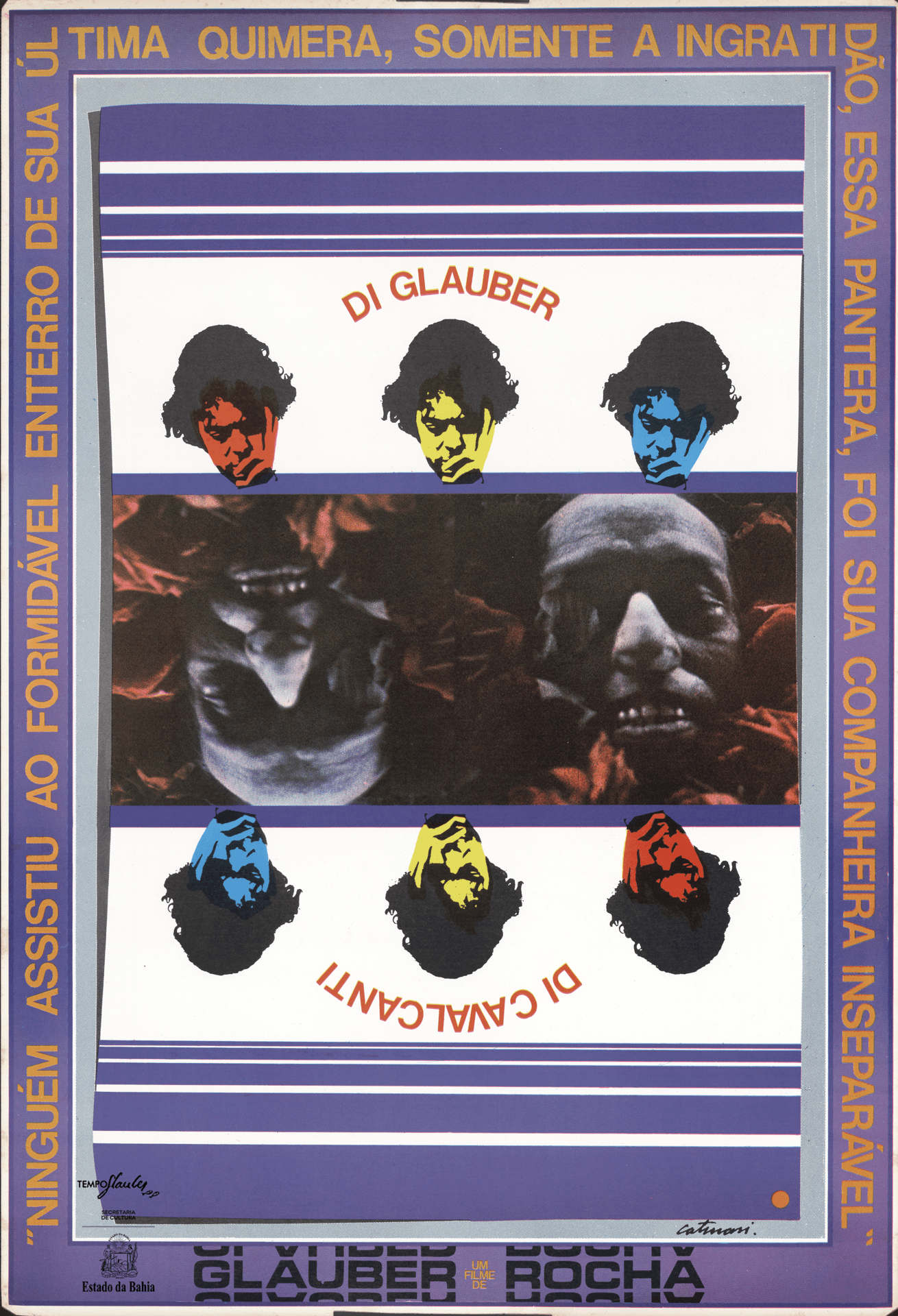
Glauber Rocha pays homage to the visual artist Di Cavalcanti. Besides talking about his deceased friend, the filmmaker discusses art and politics, overlaid on a collage of images.
1979
jorge amado no cinema
The work of the Bahian writer, his literary career, and the film adaptations of his novels, especially “Tent of Miracles” and “Dona Flor and Her Two Husbands.” “Interview with Jorge Amado at his home in Rio de Janeiro. The writer talks about his work and literary career, his books adapted for film, particularly Tent of Miracles, The Shepherds of the Night, and Dona Flor and Her Two Husbands. Friends and relatives give their opinions on the last three films based on his works. Filmmakers and actors talk about Tent of Miracles. Jorge Amado, in an intimate setting, introduces his family.”
Chrono Biography
1939
Glauber de Andrade Rocha was born on March 14th, at 3:40 AM, in Vitória da Conquista, Bahia, the first child of Adamastor Bráulio Silva Rocha and Lúcia Mendes de Andrade Rocha. The name Glauber, given by his mother, was inspired by that of the German scientist Johann Rudolf Glauber (1603-68), who discovered sodium sulfate or “Glauber’s salt”. He was baptized in the Presbyterian Church, with his mother and the pastor as godparents. His father came from a Catholic family.
It becomes mandatory for every movie theater to screen a Brazilian feature film annually. The DIP (Department of Press and Propaganda), a government agency in charge of censorship, is created. Cinédia and Sonofilmes produce musical comedies; Carmen Miranda launches the composer Dorival Caymmi in the film “O Que é que a Baiana Tem?”. Raul Roulien films Aves sem Ninho. With the growth of the Japanese community, Japanese films are regularly shown in São Paulo. Getúlio Vargas is the president of the Republic from 1934, having secured his permanence in government with the coup that established the Estado Novo in 1937.
1940
On August 27th, Ana Marcelina de Andrade Rocha, Glauber’s sister, was born.
Cinédia releases Pureza, an adaptation by José Lins do Rego. INCE (National Institute of Educational Cinema) produces Bandeirantes, by Humberto Mauro, starring Carmem Santos. The Companhia Americana de Filmes, in São Paulo, produces Eterna Esperança, by Leo Marten. Paulo Emilio Salles Gomes organizes the first Film Club in São Paulo, at the Faculty of Philosophy.
1941
The war prevents the importation of raw film stock. Atlântida Cinematográfica SA is founded in Rio. Cinédia brings theater stars Dulcina and Odilon to the cinema in 24 Hours of Dream.
1942
On October 26th, Glauber’s second sister, Anecy de Andrade Rocha, was born.
Orson Welles films “It’s All True” in Brazil. The magazine Cinearte, published since 1916, ceases publication. Film critic Vinícius de Moraes initiates a debate about silent and sound films. Brazil declares war on the Axis powers during World War II.
1943
Atlântida produces its first feature film, “Moleque Tião”, by José Carlos Burle, a success starring Grande Otelo. Cinédia releases “Samba em Berlim”, by Luís de Barros, a musical satire of Hitler and Nazism.
1944
Oscarito and Grande Otelo are reunited by Atlântida in “Tristezas não pagam Dívidas” (Sorrows Don’t Pay Debts), by JC Burle and R. Costa. Cinédia produces “Berlim na Batucada” (Berlin in the Batucada), by Luís de Barros, starring Procópio Ferreira, a satire of the friendly relations between Brazil and the USA.
1945
Glauber, at age six, travels to Rio de Janeiro with his parents.

Cinédia produces “O Cortiço,” by Luís de Barros, adapted from Aluísio de Azevedo, and invests in literary adaptations. The duo Oscarito and Grande Otelo premiere “Não adianta Chorar,” by Watson Macedo (Atlântida). Humberto Mauro begins the Brasilianas series at INCE with “Chuá-Chuá” and “Casinha Pequenina.” Getúlio Vargas is deposed by the army. Eurico Gaspar Dutra becomes president of the Republic. – Glauber, at age six, travels to Rio de Janeiro with his parents.
1946
Taught to read and write by his mother, Glauber started school at the age of seven. He attended primary school at a Catholic school in Vitória da Conquista. Glauber’s grandmother, Dona Marcelina Mendes de Andrade, passed away.
It becomes mandatory to screen three Brazilian feature films per year in each theater. Jorge Amado, a congressman in São Paulo for the Communist Party, proposes new film legislation. “O Ébrio” (The Drunkard), by Gilda de Abreu, starring Vicente Celestino, is a major success for Cinédia. The Film Club of the Faculty of Philosophy in Rio de Janeiro is created.
1947
Glauber accompanies his father on trips through the backlands of Bahia.
Luiz Severiano Ribeiro becomes the majority shareholder of Atlântida. The chanchada genre dominates Brazilian cinema with popular films and guaranteed distribution.
1948
In August, Glauber’s family moves to Salvador. His father opens the store O Adamastor in the city center. A highway engineer, his father suffers an accident that leaves him with serious injuries. His mother, at 29, takes over the business and becomes the head of the family.
Carmem Santos directs Inconfidência Mineira; Atlântida directs Terra Violenta, an adaptation of Jorge Amado’s novel. The Cinematographic Studies Circle is created in Rio de Janeiro. Film clubs emerge in Porto Alegre, Santos, and Fortaleza.
1949
In March, Glauber goes to the boarding school of the Colégio Presbiteriano 2 de Julho, in Salvador, known for its discipline and rigor. There he receives religious education and participates in the school’s festivities and choir. He writes the play “El Hilito de Oro,” staged at the school by Professor Josué de Castro. In the play, Glauber plays the main role, that of a Spanish prince.
Celebrations of the 400th anniversary of the founding of the city of Salvador on March 29th. Founding of the Vera Cruz Company in São Paulo. Atlântida produces “Carnaval no Fogo” (Carnival in the Fire), by Watson Macedo, and “Também Somos Irmãos” (We Are Also Brothers), by José Carlos Burle. Carmem Santos produces “Inocência” (Innocence), an adaptation by Taunay. The Film Club becomes the Cinematheque of the Museum of Modern Art of São Paulo.
1950
Glauber requests a transfer from the boarding school to the day school at Colégio 2 de Julho.
Television begins in Brazil with the first public broadcast, by TV Tupi, in São Paulo. Vera Cruz produces “Caiçara”, by Adolfo Celi. In Salvador, Walter da Silveira creates the Bahia Film Club. Getúlio Vargas is elected for a new term as President of the Republic.
1951
It becomes mandatory to screen one Brazilian film for every eight foreign films distributed. Vera Cruz produces “Terra é sempre Terra” and “Ângela”. Cinédia releases “Lucíola”, based on José de Alencar, and “Anjo do Lodo”, starring Virgínia Lane. The Minas Gerais Film Studies Circle is created.
1952
At age thirteen, Glauber participated as a film critic in the program “Cinema em Close-Up” on Rádio Sociedade da Bahia. Glauber’s sister, Ana Marcelina, died of leukemia, a fact that greatly impacted the entire family. His mother, Lúcia Rocha, opened a boarding house at 14 General Labatut Street. Ana Lúcia Mendes Rocha, Glauber’s younger sister, was born.
Multifilmes is founded in São Paulo. Vera Cruz produces “Tico-Tico no Fubá” and “Sai da Frente,” the debut of comedian Mazzaropi. Alberto Cavalcanti directs “Simão, o Caolho,” his first film in Brazil. Atlântida produces “Carnaval Atlântida” and “Barnabé tu és Meu,” by José Carlos Burle. Humberto Mauro films “O Canto da Saudade.” The magazine Cinelândia is launched.
1953
Glauber writes to his uncle, Wilson Mendes de Andrade, expressing his desire to be a writer. He reads Jorge Amado, Érico Veríssimo, classics of children’s literature, and philosophy (Nietzsche and Schopenhauer). He goes to the movies and reads comic books.
A severe drought in the Northeast. In Salvador, the pioneer of Bahian cinema, Alexandre Robatto Filho, releases the short film “Entre o mar e o Tendal” (Between the Sea and the Tent), a documentary about the fishing of the jackfish that marks Bahian cinema of the 1950s and Glauber Rocha’s “Barravento”. Vera Cruz produces “O Cangaceiro” (The Bandit), by Lima Barreto, “Sinhá Moça” (Young Lady), a period film, and the comedy “Uma Pulga na Balança” (A Flea on the Scale). Atlântida releases “Uma Dupla do Barulho” (A Noisy Duo), by Carlos Manga, and “Amei um Bicheiro” (I Loved a Bookie), by Jorge Ileli and Paulo Wanderley. Multifilmes produces the first feature film in color, “Destino em Apuros” (Destiny in Trouble). Alex Viany directs “Agulha no Palheiro” (Needle in a Haystack). Alberto Cavalcanti proposes the creation of the National Film Institute (INC).
1954
At the Central College of Bahia, Glauber studied classical studies. He became a member of the Circle of Study, Thought and Action (CEPA), directed by Professor Germano Machado, a Catholic, nationalist, and anti-communist. Glauber wrote the ballet “Sefanu,” “criticized by the intellectual leaders of the 3rd year, Klassyko, as Exoteryko and Homosexual.” He began attending the Film Club, encouraged by the critic Walter da Silveira.
The suicide of President Getúlio Vargas causes national commotion. Vera Cruz goes bankrupt after producing “Floradas na Serra,” starring Cacilda Becker and Jardel Filho. Alberto Cavalcanti films “O Canto do Mar” and “Mulher de Verdade.” Alex Viany directs “Rua sem Sol.” Carlos Manga directs “Nem Sansão nem Dalila” and “Matar ou Correr.” Watson Macedo directs “O Petróleo é Nosso.” The Belo Horizonte Film Magazine is launched.
1955
The group Jogralescas Teatralizações Poéticas is created, based on an idea by Fernando da Rocha Peres combining poetry and theater. Glauber directs the performances.
Nelson Pereira dos Santos directs “Rio, 40 Degrees”. Marta Rocha, from Bahia, is welcomed with a celebration in Salvador after coming in second place in the Miss Universe pageant, by two inches. The death of Carmen Miranda draws crowds to her funeral in Rio.
1956
Foundation of the Yemanjá Cinematographic Culture Cooperative Society. First performance of the Jogralescas Teatralizações Poéticas group, in September, on the anniversary of the Central College of Bahia. Glauber participates in the group, which stages Brazilian poetry, mostly by modernist poets. He meets Milze Maria Soares. He collaborates on the film “Um dia na Rampa” (A Day on the Ramp), a short film by Luiz Paulino dos Santos filmed at the Mercado Modelo in Salvador.

Juscelino Kubitschek is the President of the Republic, with João Goulart as Vice-President. Culture in Bahia receives new impetus with the creation of the School of Theatre at the University of Bahia, directed by Martim Gonçalves, the music course directed by maestro Hans Koellreuter, and the School of Dance, directed by Janka Rudzka. The Brazilian Cinematheque is created in São Paulo. “Colégio de Brotos” by Carlos Manga is released.
1957
Glauber travels to Minas Gerais, Rio de Janeiro, and São Paulo. In Belo Horizonte, he meets Adolfo Celi, Paulo Autran, and Tônia Carrero. He visits the Center for Cinematographic Studies (CEC) and makes contact with Frederico de Moraes, Maurício Gomes Leite, Flávio Pinto Vieira, Fritz Teixeira Salles, and Geraldo Fonseca, who are responsible for the editions of the Revista de Cinema and Complemento magazines. In Rio, he seeks funding for a series of films by the Yemanjá Cinematographic Culture Cooperative Society, which includes Glauber, Luiz Paulino dos Santos, Paulo Gil Soares, Fernando da Rocha Peres, José Teles, Alberico Morta, Fred Souza Castro, Jaime Cardoso, Tarcísio Araújo, Newton Rocha, and José Azulay. Among the projects is the short film “Senhor dos Navegantes”. He visits the filming of “Rio, Zona Norte” by Nelson Pereira dos Santos and meets Alex Viany.
In São Paulo, he became acquainted with the Concrete Art movement. He returned to Salvador and began studying law at the Federal University of Bahia, which he attended until his third year. Invited by Ariovaldo Mattos, he participated in the left-wing newspaper O Momento. He contributed to the cultural magazines Mapa and Ângulos and the weekly “Sete Dias”. He filmed “Pátio”, with Solón Barreto and Helena Ignez, a formalist film influenced by Concrete Art. He used leftover material from the feature film “Redenção”, by Roberto Pires. Creation of the Cinematheque of the Museum of Modern Art of Rio de Janeiro. Nelson Pereira dos Santos filmed “Rio, Zona Norte”. The comedies “Osso, Amor e Papagaios”, by Carlos Alberto de Souza Barros and César Mêmolo Jr., and “A Baronesa Transviada”, by Watson Macedo, starring Dercy Gonçalves, were released. Anselmo Duarte directed “Absolutamente Certo”. The Cinematographic Culture Magazine appears. Catholic film clubs emerge.
1958
Glauber began his journalistic career as a police reporter for the Bahia newspaper, where he worked alongside Inácio de Alencar, Ariovaldo Matos, Paulo Gil Soares, Fernando da Rocha Peres, and Calazans Neto. Later, he began publishing articles about cinema and took over the direction of the Literary Supplement. He started writing for the “Arts and Letters” page of the Sunday supplement of the Diário de Notícias newspaper in Salvador, and for the Sunday Supplement of the Jornal do Brasil (SDJB). During this time, he also worked as a civil servant for the Salvador City Hall.
Development of São Paulo’s film industry. Roberto Santos films “O Grande Momento”; Walter Hugo Khoury directs “Estranho Encontro”; “Cara de Fogo,” by Galileu Garcia, and “Rebelião em Vila Rica,” by Geraldo and Renato Santos Pereira, are released. In Rio de Janeiro, the Federation of Film Clubs emerges.
1959
Glauber travels to São Paulo to participate with Walter da Silveira in the Film Clubs Congress. He shows the rough cut of “Pátio” to Walter Hugo Khoury. In São Paulo, he meets Paulo Emílio Salles Gomes, Almeida Salles, Rudá de Andrade, Jean-Claude Bernardet, and Gustavo Dahl. He travels to Rio, where he edits and finishes “Pátio”. He launches “Pátio” in Salvador and promotes screenings in Rio. Also in Salvador, on June 30th, Glauber marries his university colleague and actress from “Pátio”, Helena Ignez. At the priest’s insistence, Glauber receives Catholic baptism and adds Pedro to his name, signing Glauber Pedro de Andrade Rocha. He spends his honeymoon at the Hotel Quitandinha in Rio de Janeiro and buys an Aryflex 35mm camera “for sixty contos with tripod and no zoom”. Shortly after his marriage, he began filming his second short film, the unfinished “Cruz na Praça” (Cross in the Square), in Terreiro de Jesus, Salvador. The film was based on a short story he wrote, “A Retreta na Praça” (The Concert in the Square), published in Panorama do Conto Baiano (Panorama of Bahian Short Stories). The film was not finished, “because when I saw the edited material, I understood that these ideas no longer worked, that my aesthetic conception was no longer the same.” He published articles about cinema in Jornal do Brasil and Diário de Notícias.

Brazilian films are now required to be shown 42 days a year. Linduarte Noronha’s “Aruanda” is filmed in Paraíba; in Rio, Paulo César Saraceni and Mário Carneiro’s “Arraial do Cabo” is filmed; and Roberto Pires’ “Redenção,” the first feature film from Bahia, is released. The production of young filmmakers from Rio, Bahia, and São Paulo flourishes. In Rio, Carlos Manga’s “O Homem do Sputnik” launches Norma Benguell’s career; in São Paulo, Rubem Biáfora produces “Ravina” and “Orfeu Negro,” directed by the Frenchman Marcel Camus and filmed in Rio, an adaptation of a play by Vinícius de Moraes – “Orfeu Negro” wins the Palme d’Or at Cannes and the Oscar for best foreign film. The Museum of Modern Art of Bahia, directed by Lina Bo Bardi, is created. In Latin America, the Cuban Revolution triumphs.
1960
Glauber Rocha’s first daughter, Paloma de Melo Silva Rocha, is born on June 12th. Glauber works as executive producer on “A Grande Feira,” a feature film by Roberto Pires, produced by Rex Schindler. With the start of filming “Barravento” by Luiz Paulino dos Santos, Glauber returns to the executive production role. After a troubled start to filming, Glauber takes over directing “Barravento,” using some rough cuts from Luiz Paulino but rewriting the script. In a letter dated November 2nd, he tells Paulo Emílio Salles Gomes how he became a director. He begins corresponding with the Cuban director Alfredo Guevara.
Joaquim Pedro de Andrade directs the short film “Couro de Gato” (Cat Skin). Carlos Coimbra releases “A Morte comanda o Cangaço” (Death Commands the Cangaço), exploring the genre of cangaceiro films. Nelson Pereira dos Santos goes to Bahia to film “Vidas Secas” (Barren Lives), but, due to the rains, films “Mandacaru Vermelho” (Red Mandacaru). The crew stays at Lúcia Rocha’s boarding house. Brasília is inaugurated. Sartre and Simone de Beauvoir visit Bahia and give a lecture in Salvador.
1961
Glauber and Helena Ignez separate. Glauber finishes “Barravento” in Rio de Janeiro, edited by Nelson Pereira dos Santos. He meets Edla van Steen, Regina Rosemburgo, and Rosa Maria Penna. Bahian cinema stands out with “Bahia de Todos os Santos” by Trigueirinho Neto, “A Grande Feira” by Roberto Pires, and “Barravento” by Glauber.
The Geicine (Executive Group of the Film Industry) is created. Jânio Quadros leaves the presidency of the Republic. João Goulart assumes power amidst a political crisis.
1962
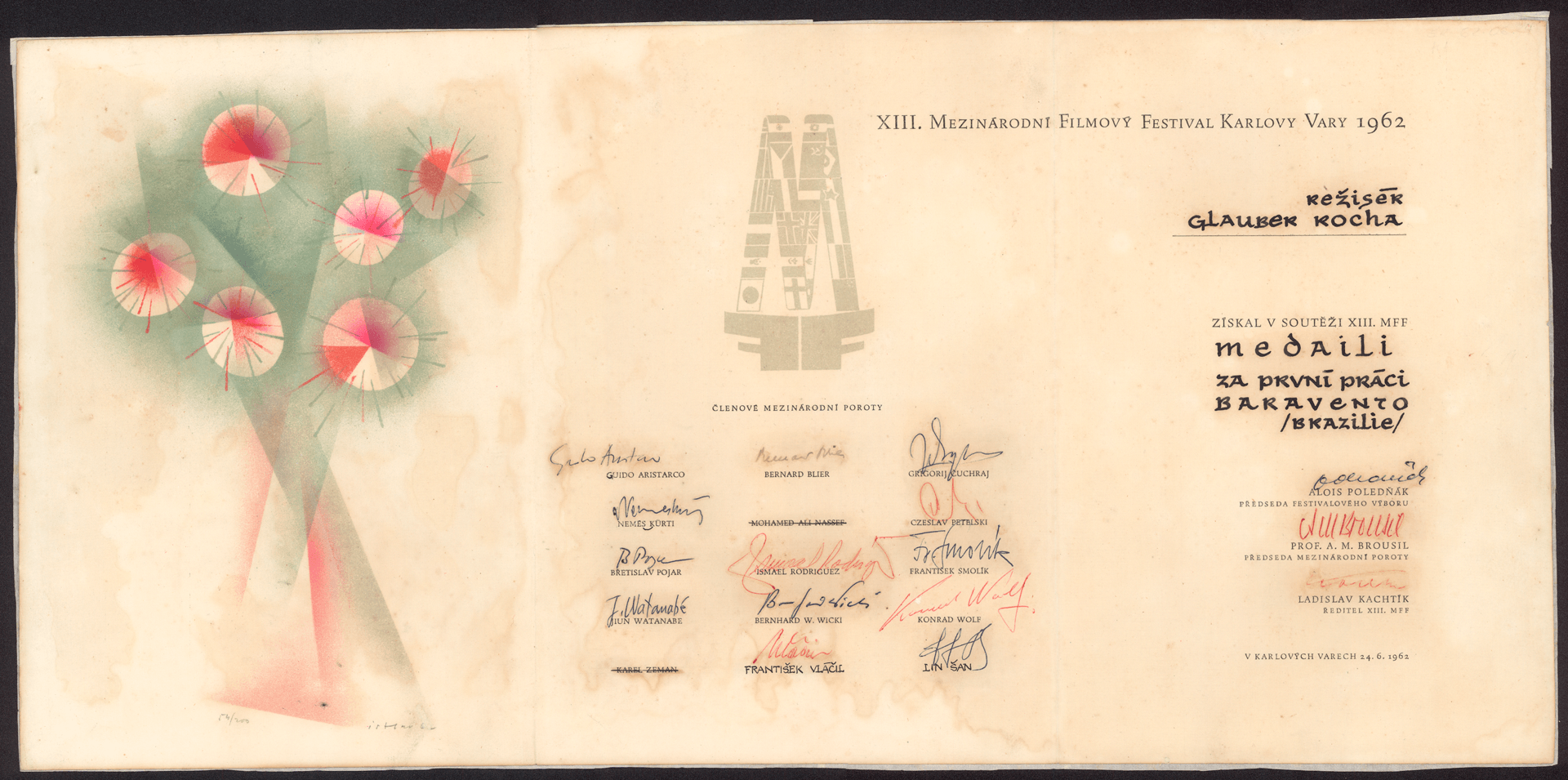
Glauber Rocha’s first trip to Europe. “Barravento” receives the Opera Prima award at the Karlovy Vary International Film Festival in Czechoslovakia. In the same year, the film is also presented at the Sestri Levanti Film Festival in Italy. Glauber participated in the Santa Margherita Film Festival in Italy. He visits Prague, Rome, Paris, and Lisbon. He produces the short film “Imagens da Terra e do Povo” by Orlando Senna. He meets the French critic Georges Sadoul on the latter’s trip to Bahia and meets him again in Karlovy Vary. Projects: in a letter to Alfredo Guevara dated November 21st, he speaks for the first time about making “América Nuestra,” an epic about Latin America that would not be realized. Paulo Emilio Salles Gomes proposes that Glauber direct the film “Dina do Cavalo Branco” in Bahia, a screenplay by Paulo Emilio that was never produced. Glauber responds to the proposal in a letter from Salvador, undated, probably from 1962.
The Cinema Novo movement begins with the explosion of film production originating in Rio de Janeiro. “Five Times Favela” is produced by the Popular Culture Center (CPC) of the UNE (National Union of Students), bringing together five short films by Leon Hirszman, Joaquim Pedro de Andrade, Cacá Diegues, Miguel Borges, and Marcos Farias. Ruy Guerra releases “Os Cafajestes” (The Scoundrels). Anselmo Duarte’s “O Pagador de Promessas” (The Given Word) wins the Palme d’Or at Carnes. The following films are released: “Boca de Ouro” (Golden Mouth) by Nelson Pereira dos Santos, “O Assalto ao Trem Pagador” (The Robbery of the Pay Train) by Roberto Farias, and “Pileiros da Guia” (Pilgrims of Guia) by João Ramiro Mello and Vladimir Carvalho. The National Council of Film Clubs is organized.
1963
On June 18th, Glauber Rocha began filming “Black God, White Devil” in the backlands of Bahia, concluding on September 2nd. He published “Critical Review of Brazilian Cinema” with Editora Civilização Brasileira. He began collaborating with the magazine Cine Cubano. On June 16th, writer Alberto Moravia wrote a laudatory review of “Barravento” in L’Espresso. According to Moravia, it is “one of the most beautiful films we have seen recently.” In August, “Barravento” was selected for the London Film Festival and, in September, included among the ten films chosen for the New York Film Festival, which inaugurated the Lincoln Center for the Performing Arts. In a letter to Paulo César Saraceni in April/May, he proposed adapting the novel “Menina Morta” by Cornélio Penna for the cinema.
The Cinema Novo movement gained visibility with three major films about the Northeast of Brazil: “Vidas Secas” (Barren Lives) by Nelson Pereira dos Santos, “Deus e o Diabo na Terra do Sol” (Black God, White Devil) by Glauber Rocha (released in 1964), and “Os Fuzis” (The Guns) by Ruy Guerra. Other films stood out: “Ganga Zumba” by Cacá Diegues, “Garrincha: Alegria do Povo” (Garrincha: Joy of the People) by Joaquim Pedro de Andrade, “Porto das Caixas” (Port of Boxes) by Paulo César Saraceni, and “A Ilha” (The Island) by Walter Hugo Khoury. The screening of Brazilian films became mandatory 56 days a year. Around three hundred film clubs participated in the national meeting in Porto Alegre. In Rio de Janeiro, Carlos Lacerda created the Commission for Aid to the Film Industry (CAIC). A political crisis ensued, with strikes, demonstrations, and rallies demanding fundamental reforms.
1964
When the military coup occurred, Glauber was out of the country, on his second trip to Europe to present “Black God, White Devil” at the Cannes Film Festival. The film competed for the Palme d’Or, was screened on May 11th, but did not win an award. Friends and family wrote to Glauber asking him not to return to Brazil immediately due to the political crisis. Glauber went to Paris and traveled through Italy. He screened his film in Mexico, traveled through the United States, went to New York and Los Angeles, and visited Hollywood. He received the Mexican critics’ prize at the Acapulco International Film Festival, the Grand Prize at the Free Cinema Festival in Italy, and the Golden Naiad at the Porretta Terme International Film Festival, also in Italy. Maurício do Valle, as Antônio das Mortes, received the Saci Award for best supporting actor from the newspaper O Estado de São Paulo. On June 19th, “God and the Devil” premiered in Rio de Janeiro at the Caruso, Bruni-Flamengo, and Ópera cinemas, among others in the Lívio Bruni circuit. On June 26th, due to the success of “God and the Devil,” “Barravento” was released in Rio at the Plaza, Riviera, Olinda, and Mascote cinemas, advertised as a film of “violence, sex, suspense, and fetishism,” featuring “the satanic beauty of a woman in the most exciting nude scene in cinema!”
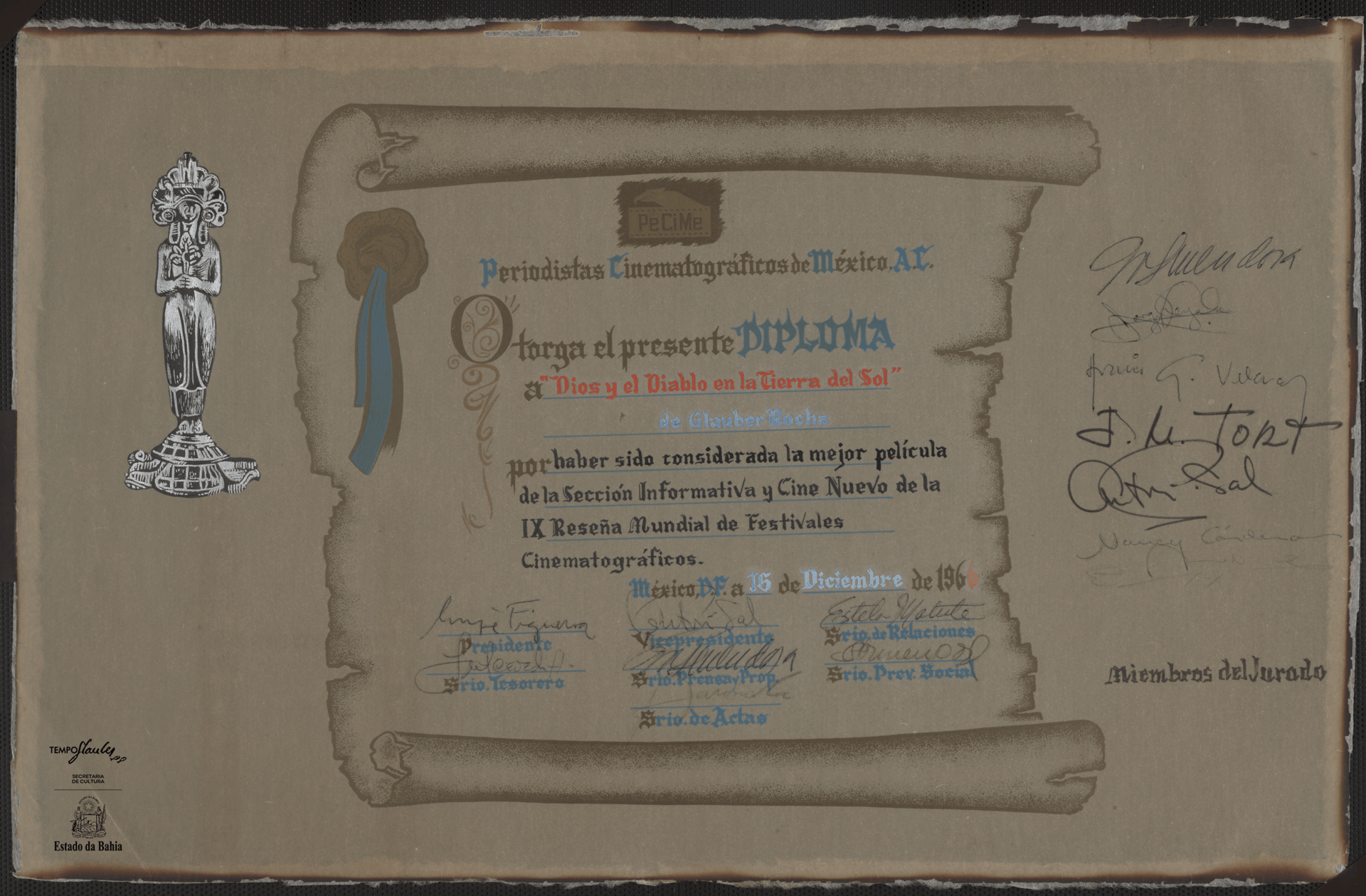
João Goulart is deposed by the military coup. Marshal Humberto Castelo Branco is appointed president of the Republic. The SNI (National Information Service) is created. Brazil breaks off relations with Cuba. The coup interrupts the filming of “Cabra Marcado para Morrer” by Eduardo Coutinho. The documentaries “Maioria Absoluta” by Leon Hirszman, “Integração Racial” by Paulo César Saraceni, “Meninos do Tietê” by Maurício Capovilla, and the films “Noite Vazia” by Walter Hugo Khoury and “Selva Trágica” by Roberto Farias are made.
1965
While still outside Brazil, Glauber launched the manifesto “The Aesthetics of Hunger,” presented in January at the Latin American Cinema Review in Genoa. The text, written on a plane between Los Angeles and Milan, lays out the aesthetic and political foundations of Cinema Novo and criticizes European paternalism towards the Third World. Mapa Filmes was founded, with Glauber, Zelito Viana, Walter Lima Jr., Paulo César Saraceni, and Raymundo (“Dico”) Wanderley Reis as partners. Glauber co-produced “Menino de Engenho” (Sugar Mill Boy), directed by Walter Lima Jr. In November, he was arrested during a protest against the military regime in front of the Hotel Glória in Rio de Janeiro, during a meeting of the OAS (Organization of American States). Also arrested with Glauber were Joaquim Pedro de Andrade, Mário Carneiro, Flávio Rangel, Antônio Callado, Carlos Heitor Cony, Jaime Rodrigues, and Márcio Moreira Alves. The arrest has international repercussions, and a telegram of protest signed by Truffaut, Godard, Alain Resnais, Joris Ivens, and Abel Gance is sent to President Castelo Branco, hastening his release from prison. At the end of the year, Glauber travels to the Amazon, where he spends Christmas 1965 filming, in Manaus and Parintins, amidst production problems, the short film “Amazonas Amazonas,” his first color film. The publisher Civilização Brasileira publishes “Deus e o Diabo na Terra do Sol” (God and the Devil in the Land of the Sun), with texts and interviews by various authors about the film. Politics, the urban landscape, and the rural world mark the productions of Cinema Novo: “O Desafio” (The Challenge), by Paulo César Saraceni, “São Paulo SA,” by Luiz Sérgio Person, “A Falecida” (The Deceased), by Leon Hirszman, “Menino de Engenho” (Sugar Mill Boy), by Walter Lima Jr., and “O Circo” (The Circus), by Arnaldo Jabor.
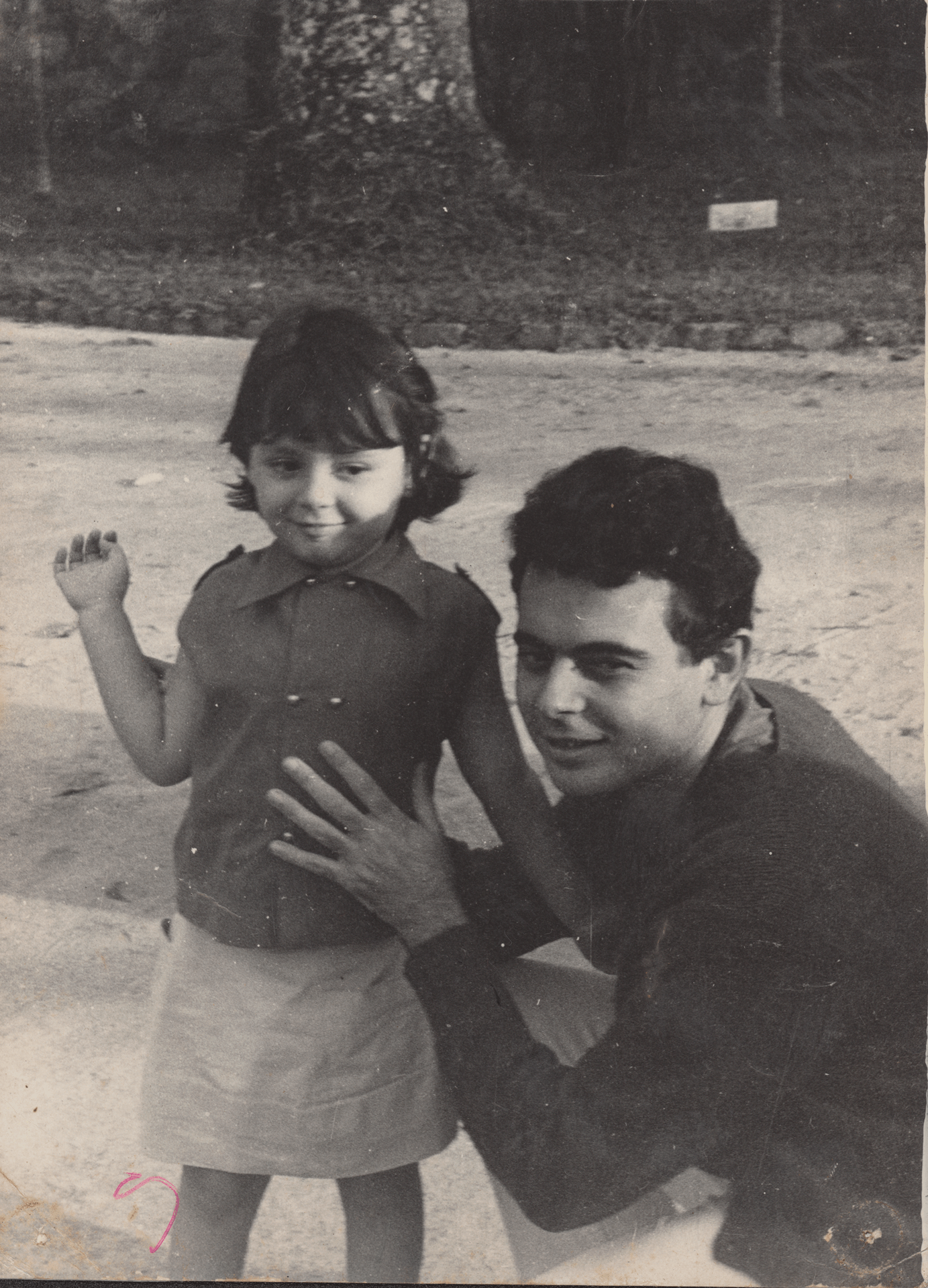
The following documentaries are produced: “Viramundo”, by Geraldo Sarno, “Memória do Cangaço”, by Paulo Gil Soares, and “Nossa Escola de Samba”, by Manuel Jimenez. Difilm, a cooperative for distributing Cinema Novo films, is founded. The film course at the University of Brasília is created. The 1st Film Festival takes place in Rio, and the Jornal do Brasil Short Film Festival. In the USA, in California, the first hippie communities emerge.
1966
At the beginning of the year, he filmed the short film “Maranhão 66,” documenting the inauguration of the governor of Maranhão, José Sarney. This experience served as inspiration for sequences depicting political campaigns in “Terra em Transe.” “Deus e o Diabo na Terra do Sol” received the Grand Latin American Prize at the Mar del Plata International Film Festival. The film’s screenplay was published in the Italian collection Cineforum. “Deus e o Diabo” was featured on the cover of the French magazine Positif no. 73, February issue, which included the manifesto “The Aesthetics of Violence” and the article “Cangaço 65, Cris du Brésil.” Glauber co-produced “A Grande Cidade,” directed by Cacá Diegues.
The Cinema Novo movement diversifies its paths with “O Padre e a Moça” (The Priest and the Girl), by Joaquim Pedro de Andrade, “A Grande Cidade” (The Big City), by Cacá Diegues, “A Hora e a Vez de Augusto Matraga” (The Hour and the Time of Augusto Matraga), by Roberto Santos, and “Os Subterrâneos do Futebol” (The Undergrounds of Football), by Maurício Capovilla. Leila Diniz stars in “Todas as Mulheres do Mundo” (All the Women in the World), a highly successful comedy by Domingos de Oliveira. The National Film Institute is created, presided over by Flávio Tambellini. Paulo Emilio Salles Gomes and Adhemar Gonzaga publish “70 Years of Brazilian Cinema”.
1967
Glauber Rocha’s third trip to Europe to present “Terra em Transe” at the Cannes Film Festival. The film is banned throughout the country in April, considered subversive and offensive to the Church. The ban makes headlines in all newspapers. It is released on May 3rd, and its screening causes controversy in Rio de Janeiro. An editorial in the Tribuna da Imprensa labels the film “anti-public.” Screened at the Cannes Film Festival, “Terra em Transe” wins the Luis Buñuel Prize, awarded by Spanish critics, and the FIPRESCI Prize – the International Federation of Film Critics. In Rio, the film is shown for four weeks in ten cinemas. In São Paulo, it is enthusiastically received by Paulo Emílio Salles Gomes, Almeida Salles, Rudá de Andrade, Roberto Santos, among others. In a session for students organized by the University Theater of São Paulo (TUSP), the film is interrupted by applause throughout its screening. The film’s impact in Brazil is recounted in letters Glauber receives from friends. From Cannes, Glauber travels to Paris. He participates in the Venice Film Festival, where he meets Luis Buñuel. At the end of July, he screens “Terra em Transe” in Locarno, Switzerland, and Montreal, Canada, where he meets Jean Renoir. At the Locarno International Film Festival, “Terra em Transe” receives the Grand Prize and the Critics’ Prize. In Havana, it is considered by Cuban critics to be the best film of the year. In Rio, it receives the Golden Dolphin Award for best film from the Museum of Image and Sound. At the Juiz de Fora Film Festival, it wins four awards: best film, honorable mention for best screenplay, best supporting actor for Modesto de Sousa, and a special award for Luís Carlos Barreto for cinematography and film production. In the same year, Glauber participates as a co-writer in “Garota de Ipanema,” by Leon Hirszman. He writes the texts: “The Revolution is an Aesthetic”; “Theory and Practice of Latin American Cinema”; “Cinematic and Tricontinental Revolution” (inspired by the Tricontinental Conference in Havana).
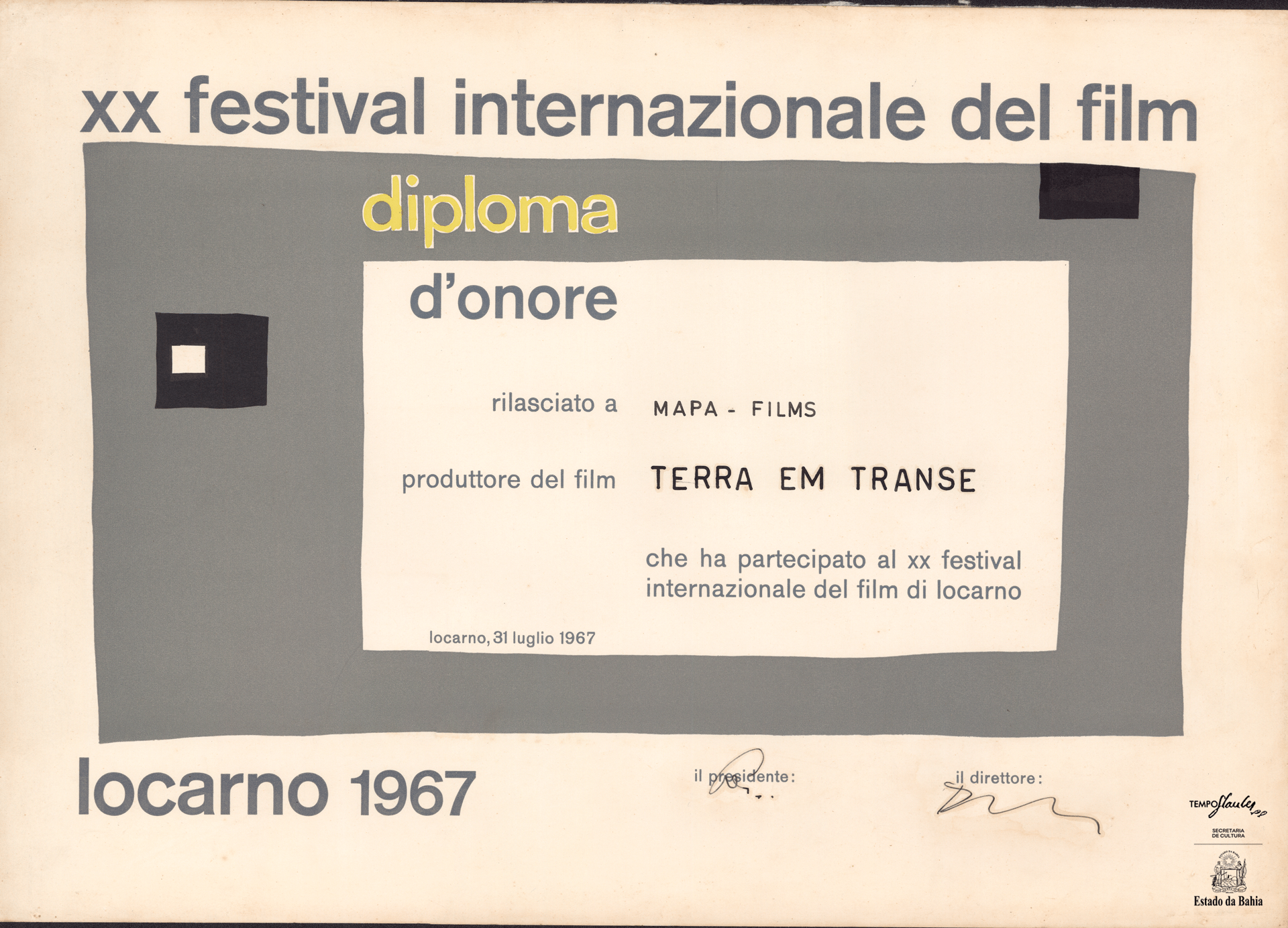
Marshal Artur da Costa e Silva is appointed president. Carlos Marighella goes to Cuba as a representative of OLAS (Latin American Solidarity Organization) and creates the ALN (National Liberation Alliance), a clandestine far-left organization. Che Guevara dies in Bolivia. Régis Debray launches his Focus Theory. “O Rei da Vela” (The King of the Candle), a play by Oswald de Andrade staged by José Celso Martinez Corrêa, and “Alegria, Alegria” (Joy, Joy), a song by Caetano Veloso, mark the beginning of Tropicalismo. Zé Celso dedicates his show to Glauber Rocha. Antônio Callado publishes “Quarup,” a novel that Glauber Rocha intended to adapt and whose project appears throughout his correspondence. The following are released: “Opinião Pública” (Public Opinion), a documentary by Arnaldo Jabor; “Garota de Ipanema” (The Girl from Ipanema), by Leon Hirszman; and “O Caso dos Irmãos Naves” (The Case of the Naves Brothers), by Luiz Sérgio Person. Modern Brazilian cinema explores new paths with “A margem” by Ozualdo Candeias, “Esta noite Encarnarei no teu Cadáver” by José Mojica Marins, and “Cara a Cara” by Júlio Bressane. Jean-Claude Bernardet publishes “Brasil Em Tempo de Cinema,” an analysis of Cinema Novo. Joaquim Pedro de Andrade directs the documentary “Cinema Novo” for German television, featuring excerpts from the filming of “Terra em Transe.”
1968
The screenplay for “Terra em Transe” is published in the January issue of L’Avant-scène du Cinéma magazine and in the German magazine Film. In March, Glauber begins preparations to film “O Dragão da Maldade contra o Santo Guerreiro” (Antônio das Mortes), “a bloody political western […] in which I revisit the character of Antônio das Mortes, ten years later, in a modernized and still barbaric backlands.” Production and financing problems delay filming in Milagres, Bahia. Glauber cancels his trip to Paris to meet the producer of “O Dragão,” Claude-Antoine, due to the May 1968 protests. While waiting for filming in Bahia, in August, in Rio, he shoots “Câncer” with a 16mm Éclair camera, an experimental film with improvised situations revolving around violence, racism, and sexuality. He documents the student marches against the dictatorship in the short film “1968.” Glauber interrupts filming of “The Dragon” to participate in the Cinema Novo week in New York. There, he meets Elia Kazan, watches the filming of “The Arrangement,” and tries to obtain the film rights from Kazan for William Faulkner’s novel “Wild Palms,” which places the Hero between Pain and Nothingness […] Faulkner prefers “Vidorida” (survival in struggle!).” The project would not be realized, but Glauber takes it up again throughout his career. In Brazil, he participates in a seminar on cinema and television in Latin America, organized by UNESCO at the University of São Paulo. The meeting brings Roberto Rossellini, Edgar Morin, and the Cuban Alfredo Guevara to Brazil. He co-produces “Brazil Year 2000,” a feature film by Walter Lima Jr. starring Anecy Rocha, Glauber’s sister and wife. In his letters, he begins to talk about leaving Brazil permanently. Projects: in a letter to producer Claude-Antoine, he proposes to make a television series with the character Antônio das Mortes as the protagonist. He writes the outlines for thirteen episodes and the series’ presentation. Glauber proposes during this period The most diverse projects, still thinking about filming some of them in Brazil: a musical called “O Rei do Bicho” (The King of the Beast), “a very loose adaptation” of Brecht’s musical comedy, “The Threepenny Opera,” about the life of a gangster. “I know the Samba Schools and all the great samba dancers. Here, for this genre of film, you don’t need Hollywood choreography. We have everything.” “A script of espionage adventures in the exotic Amazon. I’ve been to the Amazon and I have fabulous material that could REALLY be more fascinating than James Bond […] I don’t want to direct, I don’t even want to sign the script. I want to sell it because I need the money.” “Themes taken from the novels of Miguel Angel Asturias.” “The project of Caligula, by Camus, to be filmed in the ruins of Pompeii,” with the actor Jean-Pierre Léaud. Project of “adaptation of the play Galileo Galilei, by Brecht, to a future era of controversy about the conquest of space,”a project that might also interest Orson Welles.”
The March of the 100,000 in Rio, with students and intellectuals protesting against the dictatorship. Institutional Act No. 5 closes Congress. Urban guerrillas erupt. Gilberto Gil releases the album Tropicália and Caetano Veloso, the song “É proibido proibir” (It’s Forbidden to Forbid). The Superior Council of Censorship is created. Underground cinema produces a classic, “O Bandido da Luz Vermelha” (The Red Light Bandit), by Rogério Sganzerla, and “Jardim de Guerra” (Garden of War), by Neville d’Almeida. Cinema Novo releases “Fome de Amor” (Hunger for Love), by Nelson Pereira dos Santos, and “O Bravo Guerreiro” (The Brave Warrior), by Gustavo Dahl. The “Boca do Lixo” (Trash Mouth) cinema in São Paulo emerges, with Carlos Reichenbach, João Callegaro, and Antônio Lima. Student demonstrations in “May ’68” in France.
1969
Glauber Rocha proposed to American producer Daniel Talbot that they adapt “Amor de Perdição,” a novel by the Portuguese writer Camilo Castelo Branco, transforming it into a “love tragedy in the underdeveloped world,” with João Gilberto or Baden Powell in the lead role and music by Tom Jobim. He traveled to Europe to screen “O Dragão da Maldade contra o Santo Guerreiro” at the 1969 Cannes Film Festival, which earned Glauber the Best Director award, as well as the FIPRESCI prize, the Luis Buñuel prize, and the prize from the International Confederation of Art and Essay Cinema. Glauber attributed the award to the enthusiasm of Luchino Visconti, a member of the jury, for the film. In Belgium, the film won the First Prize at the Plovaine Film Festival. In Brazil, it received the Golden Owl Trophy and the Additional Quality Award from the National Film Institute. The Peruvian magazine Hablemos de Cine published an interview with Glauber in April, under the title “Glauber: The Trance of Latin America.” The French magazine “Cahiers du Cinéma” published an interview with Glauber Rocha in its July/August issue. In Cannes, before the awarding of the “Dragon” prize, Glauber received a proposal from Pere Fages, a film producer from Barcelona, to make a $100,000 film to be shot in Spain, with total creative freedom. The film would be “Cabezas Cortadas” (Severed Heads), and Glauber proposed Orson Welles for the role of the Latin American dictator, a role that would be played by Francisco Rabal. He traveled to Paris, where producer Claude-Antoine invited him to make a film in Africa, which would be “O Leão de 7 Cabeças” (The Lion with 7 Heads). He traveled to Rome and participated in the Venice Film Festival. In Italy, in Rome, he participated in “Vent d’Est” (East Wind), a film by Jean-Luc Godard about political cinema. Glauber played the role of a revolutionary filmmaker who points the way for Third World cinema. He traveled to Brazzaville, Congo, in September to film “O Leão de 7 Cabeças”. From there he writes to his mother saying, “I’m in Africa. There aren’t so many animals here. It’s very hot. It’s like Bahia. The people are great. The work is hard.” He shoots the film in 22 days. In the middle of filming, the French actor Jean-Pierre Léaud has a hysterical fit; the Congolese think it’s part of the film. In a letter to the Cuban Alfredo Guevara, of ICAIC, he asks him to show “The Dragon” to Fidel Castro and recommends the guerrilla fighter Itoby Alves Correa, “Hélio,” during his stay in Cuba. Médici assumes the presidency.
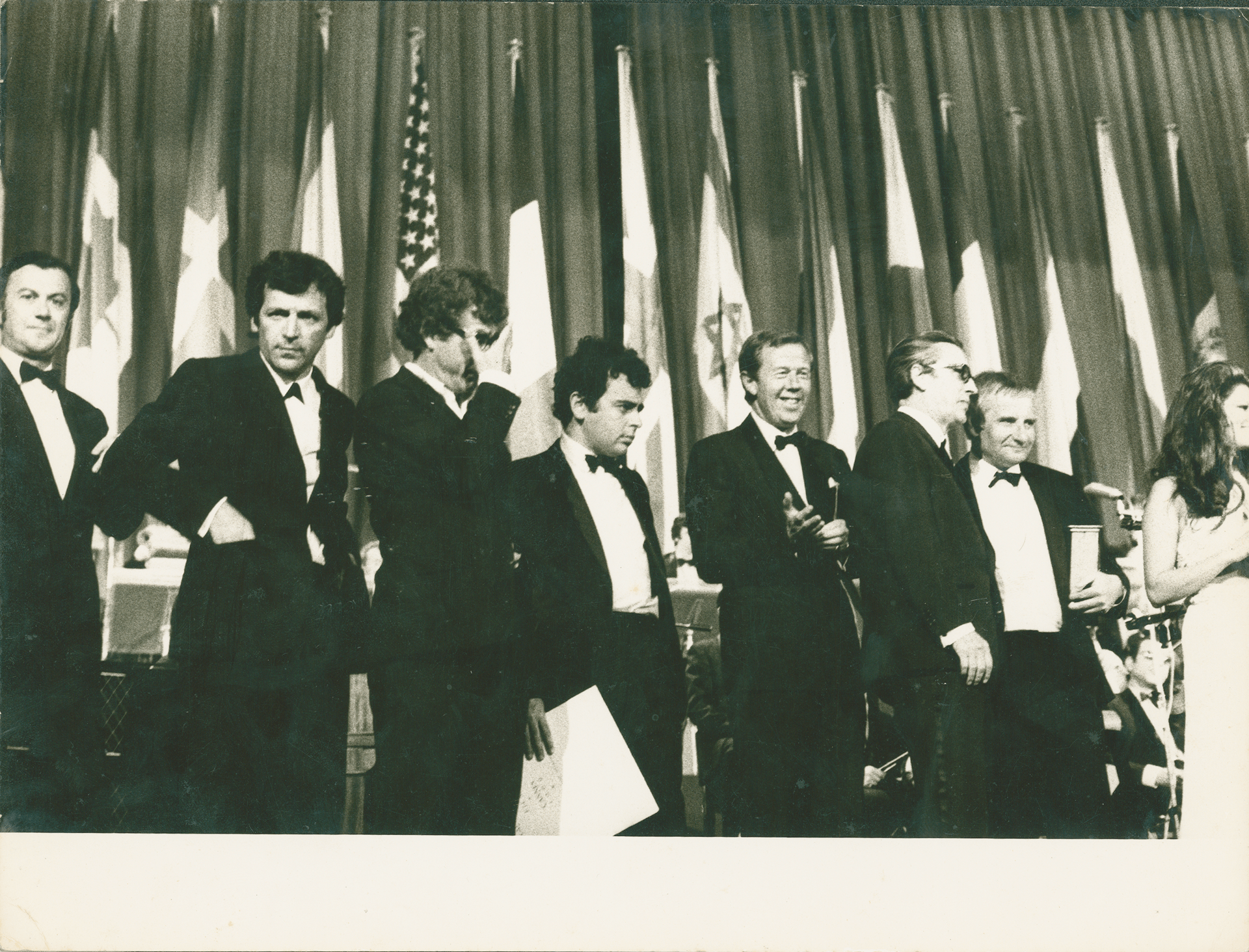
Embrafilme is created. Repression leads to the closure of film clubs. “Macunaíma”, by Joaquim Pedro de Andrade, is the great success of Cinema Novo. “Os Herdeiros”, by Cacá Diegues, “Brasil ano 2000”, by Walter Lima Jr., “Memória de Helena”, by David Neves, and “Copacabana me Engana”, by Antônio Carlos Fontoura, are released. Underground cinema makes its presence felt with “O Anjo Nasceu” and “Matou a família e foi ao Cinema”, by Júlio Bressane, “Meteorango Kid”, by André Luís Oliveira, and “Meu Nome é Tonho”, by Ozualdo Candeias. Reginaldo Farias makes “Os Paqueras”. Cinema Novo refuses to participate in the 1969 Rio Film Festival as a political protest. During the festival, filmmaker Joaquim Pedro de Andrade is arrested and released due to pressure from international personalities present at the event. The ALN and MR-8 kidnap the American ambassador in exchange for the release of fifteen political prisoners. Carlos Marighella publishes the Minimanual of the Urban Guerrilla. Captain Lamarca joins the armed struggle.
1970
Glauber Rocha travels to Catalonia, Spain, where he films “Cabezas Cortadas” (Severed Heads) between February and March. He goes to New York to attend the premiere of “O Dragão” (The Dragon). He returns to Spain, where he finishes editing “Cabezas Cortadas”. In Brazil, censorship demands that the film, spoken in Spanish and Catalan, be dubbed into Portuguese to receive a Brazilian film certificate. “O Leão de 7 Cabeças” (The Lion with 7 Heads) is rejected by the Selection Committee of the Cannes Film Festival. In July, “Cabezas Cortadas” is shown for the first time at the San Sebastian Film Festival and in August it is released at the Venice Film Festival. Both films generate controversy and enthusiastic and indignant reviews. Glauber does not attend the festivals. Released in France, the films are not well received. He returns to Brazil and, in November, begins writing for the weekly newspaper O Pasquim. He travels to Petrópolis, Cabo Frio, and Bahia. He breaks off his relationship with Rosa Maria Penna. He meets Letícia Maria Moreira de Souza. The increasing repression and the imprisonment of Walter Lima Jr. led him to give up working in Brazil. Among the unrealized projects was a film adapted from the novel “Terras do Sem-fim” by Jorge Amado for RAI, and an adaptation of the novel “Menina Morta” by Cornélio Penna. He spent Christmas in Rio. In a letter from Rio, dated August 1970, to the production company Mapa Ltda., he proposed a film based on “Quincas Berro d’Água” by Jorge Amado, directed by Glauber Rocha, with a budget of 150,000 dollars.
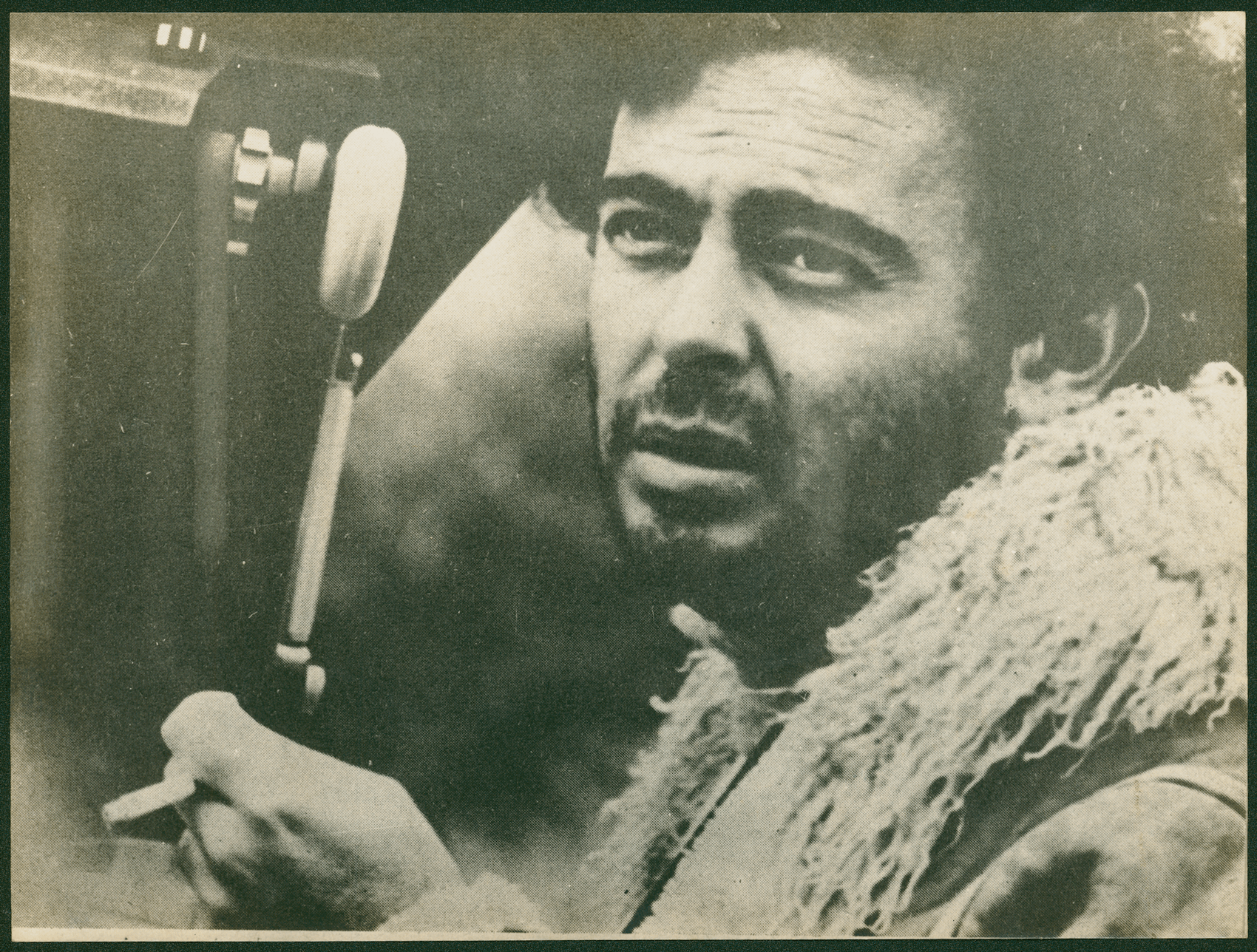
Brazilian films are now required to be shown for 112 days a year, then reduced to 98 days. Guerrillas kidnap the ambassadors of West Germany, Switzerland, and Japan in exchange for the release of political prisoners. Brazil wins the 1970 World Cup, and the euphoria is capitalized on by the dictatorship. The films of Cinema Novo are markedly allegorical: “Azyllo Muito Louco” by Nelson Pereira dos Santos, “Os Deuses e os Mortos” by Ruy Guerra, and “Pindorama” by Arnaldo Jabor. Filmmakers Júlio Bressane and Rogério Sganzerla create the production company “Bel-Air” and go into exile. Underground cinema produces “O Pornógrafo” by Callegaro, “Orgia ou O homem que deu Cria” by Silvério Trevisan, and “Jardim de Espumas” by Luiz Rosemberg Filho. Walter Lima Jr. makes “Na boca da Noite,” which, poorly released in Rio, is little seen. Censorship bans “Prata Palomares”, by André Faria, and “O país de São Saruê”, a documentary by Vladimir de Carvalho.
1971
He travels to New York in January and begins an exile that would last five years, at a time when political repression and persecution become more severe. He settles in an apartment in the Village, owned by Fabiano Canosa. Also in January, he is invited to a conference at Columbia University. The Spanish edition of *Revisão Crítica do Cinema Brasileiro* (Critical Review of Brazilian Cinema) is published. In May, Glauber goes to Santiago, Chile, where he begins, with Norma Benguell and Zózimo Bulbul, a documentary with the provisional title “Definição ou Estrela do Sol” (Definition or Star of the Sun), about Brazilian exiles. The film began with Glauber whistling an off-key version of the National Anthem. It was not completed and the filmed material was lost. The film was produced by Renzo Rossellini and Chilean National Television. Glauber travels to Buenos Aires and London, where he meets Caetano Veloso and other exiles, and then goes to Paris. He goes to Munich, where he meets the German filmmaker Peter Fleischmann. He travels to Rome. He acts in the film “O Rei dos Milagres ou Tatu Bola” (The King of Miracles or Armadillo), a feature film by Joel Barcelos and Gianni Barcelloni, in which he plays the role of a governor. He travels through Morocco with Letícia Moreira de Souza and Mossa (Flora Bildner). He films the trip in Super 8 (Letícia and Mossa in Morocco). He returns to Rome, goes to Paris, and travels to Cuba in November, proposing to film “América Nuestra” with the support of ICAIC. He recommends Marcos Medeiros’ project, “História do Brasil” (History of Brazil). “América Nuestra” is not made, and Glauber becomes involved in the production of “História,” which he would co-direct. In Cuba, he marries the journalist Maria Tereza Sopeña. His book, Revisión Critica del Cine Brasileño (Critical Review of Brazilian Cinema), a Spanish version, is published in Madrid by Editorial Fundamentos.
Former champion and guerrilla fighter Carlos Lamarca is killed in Bahia. The films “Como era “Gostoso o Meu Francês” by Nelson Pereira dos Santos and “A Casa Assassinada” by Paulo César Saraceni are released. Underground or marginal cinema gets a retrospective at the Cinematheque of the MAM (Rio de Janeiro). The Cinema Novo vs. Cinema Marginal debate intensifies. “O Capitão Bandeira contra o dr. Moura Brasil” by Antônio Calmon and “Bang Bang” by Andrea Tonacci are released.
1972
In Cuba, unable to film “América Nuestra,” Glauber dedicated himself to the project “História do Brasil” (History of Brazil), a montage of excerpts from 47 Brazilian films archived at ICAIC. He obtained permission to travel to Rome and Paris to buy about 2,000 books for research and the film’s script, which would only be completed two years later in Rome. In Cuba, he interviewed and observed the training of guerrillas. He met exiles and leaders of the left: Vladimir Palmeira, Lizt Vieira, José Dirceu, Fernando Gabeira, Onofre Pinto. He met with Régis Debray and Miguel Arraes, who visited Havana. He wrote the prologue to “Grande Sertão Veredas” for the Cuban edition. He remained in Cuba until December 1972. He traveled through Latin America: Buenos Aires and Montevideo, in Argentina; In Punta del Este, Uruguay, he met with former president João Goulart and his family (his mother Lúcia Rocha, his sister Anecy, his brother-in-law Walter Lima Jr., and his daughter Paloma). He went to Lima and Machu Picchu in Peru, and traveled to Bogotá, Cartagena, Barranquilla, and Panama. During his trip to Colombia, Glauber met Paula Gaitán in Bogotá, then a teenager, whom he would meet again in Brazil in 1976 and with whom he would live until his death in 1981. Glauber lived in Paris with the Cuban Maria Tereza. In a 1974 letter to Zelito Viana, he retraces the events of that period: “I enjoyed the best moments of my life in exile, reuniting with my family and Jango in Punta del Este. I traveled through Peru and Argentina, flew over the Chilean ‘Belorizonte’ (which I had already seen in ’71), learned a bit about Latin American politics from Darcy and gained other knowledge, entered through Colombia, left Cartagena ‘criajando’ (a Brazilian slang term for a drunken stupor) during Holy Week to go see Bolívar’s tomb in Barranquilla, the land where Gabo wrote ‘Macondo’. I spent two days in Panama, arrived in New York where I had a private concert with João Gilberto, saw Francis again, arrived in Paris, set up a fourth studio with Tereza in the style of the last tango, and wrote the screenplay for ‘The Age of the Earth’ in exchange for a ten thousand dollar prize from the Arab (Raman), Zionist (Braunsberg) producers, under the biggest scolding of my life, culminating in the extremely violent separation from Tereza and the death of the jealous Regina.” [Rosemburgo], reappearance of Rosinha [Rosa Maria Penna]”. In a July letter to Cacá Diegues, he communicates that he has edited “Cancer”, filmed in 68: “imagine that I finished “Cancer” which is exceptional, but the French customs seized the copy of the negative, they’re giving me a hell of a runaround to release it.
The dictatorship organizes the celebrations for the 150th anniversary of Brazil’s Independence. The poet Torquato Neto, one of the spokespeople for Tropicalismo, commits suicide. Leila Diniz dies. The mandatory screening of Brazilian films is reduced to 84 days a year. The First Congress of the Brazilian Film Industry takes place in Rio de Janeiro. The following films are released: “Independence or Death”, by Carlos Coimbra, a historical-patriotic film; “The Virgin Widow”, a softcore pornographic comedy by Pedro Rovai; “The Conspirators”, by Joaquim Pedro de Andrade; “São Bernardo”, by Leon Hirszman; and the documentary “Migrants”, by João Batista de Andrade. The first Short Film Festival takes place in Salvador.
1973
Glauber lives between Paris and Rome. On February 7th, the Mapa production company is informed that the film entitled “Cabeças Cortadas” (Cut Heads), submitted to censorship in January of the previous year, had been denied authorization to be shown, by order of the Director of the DCDP [Division of Censorship of Public Entertainment] […] “for reasons of inciting incitement against the current regime, public order, its authorities and its agents”. In April, he receives a letter from the President of Chile, Salvador Allende, congratulating him on his public support for his government. The negatives of “O Dragão” (The Dragon) and “Terra em Transe” (Land in Anguish) are burned in a fire in laboratories in France, on the night of June 25th to 26th. In September, he wrote from Rome to Alfredo Guevara, explaining that he had separated from Tereza: “There was no political rupture between her and me [sic]. The crises of incompatible temperaments worsen, and separation in these cases is the best solution. Tereza is a very intelligent, cultured, and highly sensitive woman. She is a revolutionary and embodies the great contradictions of a Cuban woman of her generation.” In Italy, he participated in the Pesaro Film Festival and settled in Rome, at the home of producer Gianni Barcelloni, to stage “History of Brazil,” with the help of producer Renzo Rossellini and the participation of Radiotelevisione Italiana (RAI). In an August letter to João Carlos Rodrigues, Glauber wrote about the behind-the-scenes of Brazilian politics, information that explains his support for President Geisel’s opening policy in 1974. He met with researcher Raquel Gerber in Rome and suggested a collection of his work based on texts published in Europe and the USA. He wrote the screenplay for RAI’s “The Birth of the Gods” (La Nascita Degli Dei), “a six-hour film about Eastern and Western civilizations,” divided into two parts: Cyrus, moon of the East, and Alexander, sun of the West. The film was never made. In a letter to Paulo Emilio, he summarized the period as follows: “The year 1973 in Europe was a struggle against hunger and finishing the film ‘History of Brazil,’ interrupted several times to write screenplays prepaid by producers (this paid screenwriting is what has sustained me, although the projects are unfilmable because I myself give up: this has happened about four times, etc.)”. In November, he met former president João Goulart again in Paris. And the book Le Cinéma Novo n° 2/Glauber Rocha, a collection of essays on Glauber Rocha, was published in France in the Études Cinématographiques collection, n° 97/99. Ed. Minard.
First Gramado Film Festival, in Rio Grande do Sul. Paulo Emilio Salles Gomes publishes the essay Cinema: Trajectory in Underdevelopment. Brazilian film clubs reorganize. The ABD (Brazilian Association of Documentarians) is formed. The following films are released: “Uirá, an Indian in Search of God”, by Gustavo Dahl; “All Nudity Will Be Punished”, by Arnaldo Jabor; “Joana Francesa”, by Cacá Diegues; “The Condemned”, by Zelito Viana. In Chile, President Salvador Allende is killed during the military coup of September.
1974
In March, Visão magazine published a letter in which Glauber Rocha defined General Golbery do Couto e Silva as a “genius of the race,” and affirmed his belief in the process of political opening led by the new president Ernesto Geisel and the military. The letter provoked controversy and accusations. In a previous letter, from the same period, from Rome, to Zuenir Ventura, he said: “I, a poor man, manage very well, connected to the homeland: if there are elections, find me a party so I can run for President.” René Gardies published the book Glauber Rocha in France, through Éditions Serghers, based on his doctoral thesis defended in Paris. Glauber fell in love with the French actress Juliet Berto. He went to Lisbon, Cannes, and Capri. In June 1974, he wrote from Rome: “I married ‘La Chinoise’ Juliet Berto. This time it’s forever.” In Rome, he finished “History of Brazil.” The ICAIC (Cuban Institute of Art and Industry) withdrew its support and name from the film’s credits due to aesthetic and political disagreements. He begins preparing for the production of “The Birth of the Gods,” with locations planned for Egypt and Greece. In July, his daughter Paloma Rocha visits him in Paris. He films a trip on Super 8 with Juliet Berto. In August 1974, he writes: “I’m going to Egypt with Juliet to scout locations and get a budget, and in September I’ll prepare everything here to film in October. If, due to unforeseen circumstances, the film doesn’t get made, I’ll go straight to New York with the other script, ‘The Age of the Earth,’ and with enough money to live there until the production is complete.” He travels to Egypt and Greece. From Egypt, he sends a postcard to his family that says: “I’m here with Juju [Juliet Berto] doing location scouting. Egypt is like Northeast Brazil. Everything’s fine. Now I’m going to catch a plane to Babylon. I’ll be back at the end of ’75.” He returns to Rome and Paris in ’74. Under the impact of the assassination of filmmaker Pier Paolo Pasolini on November 2nd, he writes the article “Macho Love” for O Pasquim. Other projects: filming “Das Kapital,” with Orson Welles as Karl [Marx] and Dirk Bogarde as Friedrich [Engels] in the old proletarian, monarchical, colonialist London of the last century.”
General Ernesto Geisel assumes the presidency of the Republic. Roberto Farias takes over the direction of Embrafilme. The following films are released: “O amuleto de Ogum” by Nelson Pereira dos Santos; “Guerra Conjugal” by Joaquim Pedro de Andrade; “Rainha Diaba” by Antônio Carlos Fontoura. The film “Iracema” by Jorge Bodansky and Orlando Senna is banned. Experimental cinema resurfaces with “Triste Trópico” by Arthur Omar and “O Rei do Baralho” by Júlio Bressane. Paulo Emilio Salles Gomes publishes Humberto Mauro, Cataguases, Cinearte.
1975
In January, he traveled to Mexico to raise co-production funds for “The Age of the Earth.” He also negotiated a co-production with Ecuador and Venezuela. Glauber intended to shoot “The Age of the Earth” “half in Mexico, Ecuador, or Venezuela and half in the United States: San Francisco and New York.” He did not obtain the desired funding. In Rome, he filmed “Claro,” with Juliet Berto, Carmelo Bene, and interventions by Glauber himself, between April and May. “Claro” premiered in Rome in October and generated controversy. It was not well received at the Taormina Film Festival. Screened at the Paris Film Festival in November, the film received violent reviews. The French critic Jacques Scliar, from Le Monde, wrote: “Unfortunately, the author’s contempt for ‘bourgeois’ language and his taste for imprecation lead him this time beyond what is bearable.” Jean-Louis Bory, from Nouvel Observateur, spoke of “confused and above all unbearable narcissism.” In a letter to Alfredo Guevara in November of that year, he wrote: “I made a film in Rome, ‘Claro,’ which received excellent and terrible reviews. A new film. I want you to see it. I filmed it in 11 days, for $50,000, 9,000 meters of film.” In the “Il Castoro Cinema” collection, published by La Nuova Italia in Florence, issue number 13 is dedicated to a study of Glauber Rocha’s work, authored by Cinzia Bellumori. In November, he received a note from Orson Welles offering to meet him in Paris. Projects: In a letter to Cacá Diegues in August, he wrote: “I’m returning to Rome to film ‘Revolução.’ I wanted to do it in Paris, but it’s not possible.” There are no other references to the project. Writings: According to a letter from editor Ênio da Silveira in November, Glauber was preparing a 750-page novel called “História do Brasil” (probably the result of research for the film of the same name); and a volume entitled “Films of Glauber Rocha”, a book with the screenplays of his films; and also “Alexander the Great”, a four-hundred-page book (probably part of the research or screenplay for “The Birth of the Gods”, written for Italian TV). Glauber begins to plan his return to Brazil. In letters to friends, he always mentions financial difficulties. In November, he writes to João Carlos Teixeira Gomes about the possibility of becoming an international correspondent for the Bahia newspaper and announces: “If I return to Brazil, I would return to Bahia, where I want to be Governor, as I said in Pasquim”. In December, he writes to Peter B. Schumann about the possibility of working in Germany. He prepares his book on Cinema Novo (The Revolution of Cinema Novo). He separated from Juliet Berro at the turn of 1975 to 1976. He went to the Saint-Jacques Convent, of the Dominican order, in Paris, at the suggestion of his friend Itoby Alves Correa, who feared that the persecution of the terrorist Jackal would lead the French police to the Latin American guerrillas and militants based in Paris. He proposed to Juliet Berro that she go with him to the USA.
Brazilian films are now required to be shown 112 days a year. Brazil reaches 3276 movie theaters. Films: “The King of the Night” by Hector Babenco, “Lesson of Love” by Eduardo Escorel. Documentaries: “Tarumã” by Aloysio Raulino, “Ghost Train” by Alain Fresnot. The Brasília Film Festival resumes after three years. The Pesaro Film Festival dedicates a section to Brazilian cinema. The assassination of journalist Wladimir Herzog. Publications in the alternative press grow. Maria Rita Galvão’s “Chronicle of São Paulo Cinema” is published.
1976
Glauber travels to Moscow in January, where he stays for two weeks. From there he writes to Paulo Emílio recounting his time in Georgia, his visit to the Eisenstein collection in Moscow, and a meeting with Luís Carlos Prestes: “The Knight of Hope is very intelligent, witty, strong, active, and highly cultured despite his 78 years. He made an excellent impression on me; it was an informal interview that I will publish someday.” In Moscow, he seeks funding for a film entitled “The Birth of the Earth” (with elements from previous projects: “América Nuestra,” “The Birth of the Gods,” and “The Age of the Earth”). He writes: “I am willing to return to Brazil even if it means facing a lawsuit.” He receives an invitation from producer Daniel Talbot to go to California to present his films at universities. In Talbot’s letter of January 15th, there is a handwritten note from Francis Ford Coppola to Glauber Rocha replying that he could not produce “The Age of the Earth” nor help him in the US, as he was going to film in the Philippines (Apocalypse Now). Project: In a letter to Peter B. Schumann, from January 1976, he says: “I have a theme for Paris: a documentary about the unemployed of the Third World in Paris: me, the blacks, the Arabs, the South Americans…it’s a film-truth, improvised. I, an unemployed filmmaker, interview other unemployed Third World people.” In a letter to Cacá Diégues, from January, he says: “I also finished ‘The Dialectical History of Matter’, now I am a philosopher-writer.” Glauber Rocha goes to California, where he presents his films at the Universities of Berkeley, Stanford, and Fresno. In the US, he tries to raise funding for the projects: “The Age of the Earth”, “The Birth of the Gods”, and for the adaptation of William Faulkner’s “The Wild Palms”. In Los Angeles, Glauber has his passport released by the Itamaraty (Brazilian Ministry of Foreign Affairs) to return to Brazil, through the intervention of General Golbery do Couto e Silva. From Los Angeles he writes to Jorge Amado: “I am finishing my book written during these five years of exile: it’s called ‘Universe’, it should be four hundred pages long and I think it’s very good… I made a literary transaction with you, with Rosa, Zé Lins, Graciliano”. He returns to Brazil on June 23rd, after five years of exile. In September, from Rio, he writes to Raquel Gerber: “Know that I have a total of thirteen books to publish, including a film book (500 pages), a novel (Universo), a Romanceiro do sertão (300 pages), a Fantástico Folhetim (1968) and the diary of exile, in addition to poems and Mapa da Bahia, which are all my poems, short stories and plays that I haven’t published. […] I’m going to film a Globo Repórter segment called “Introduction to Villa-Lobos”, to be released on November 15th. I asked for 5,000 dollars for half an hour and total freedom. They paid without asking for a script. […] I will stage the operas “O Guarani” and “Yerma” by Villa-Lobos-Lorca and I will be living in Bahia.” In Rio, he meets Maria Aparecida Braga (Cuca). He films the wake of the painter Di Cavalcanti,On October 27th, at the Museum of Modern Art. The filming of the funeral caused controversy and would later lead to the film being banned by the courts at the request of the painter’s adopted daughter, Elizabeth Di Cavalcanti. On October 28th, she wrote to João Carlos Rodrigues about the filming and reported health problems: “I was in the hospital three times for psycho-gastric problems.”
João Goulart dies in exile. Juscelino Kubitschek dies in a car accident. The bishop of Nova Iguaçu, in Rio de Janeiro, is kidnapped. The Brazilian Bar Association (OAB) in Rio de Janeiro and Cebrap in São Paulo suffer attacks. The National Film Council (Concine) is created. “Dona Flor and Her Two Husbands,” by Bruno Barreto, reaches 10 million viewers, “Xica da Silva,” by Cacá Diegues, reaches 3 million viewers. The following films are released: “The Fall,” by Ruy Guerra and Nelson Xavier, “Hallelujah Gretchen,” by Sylvio Back, the documentaries “Iaô,” by Geraldo Sarno, “The Stone of Wealth,” by Vladimir de Carvalho, “The Independence of Mozambique,” by José Celso Martinez Corrêa. “The Belle Époque of Brazilian Cinema,” by Vicente de Paula Araújo, is published.
1977
On March 27th, Anecy Rocha died in Rio de Janeiro after falling down an elevator shaft. His sister’s death deeply affected Glauber Rocha. He interrupted his novel “Riverão Sussuarana” and incorporated the tragedy into the book’s text. The short film “Di,” featuring images from the funeral of painter Di Cavalcanti, won the special jury prize at the Cannes Film Festival. Glauber wrote: “It is the most modern and revolutionary film of the 70s in the world. It is new in framing, sound, acting, editing – a Baroque-epic novelty.” He directed the medium-length film “Jorjamado no Cinema,” produced by Embrafilme for television broadcast. On August 4th, Pedro Paulo de Araújo Rocha, son of Glauber and Maria Aparecida de Araújo Braga, was born. Glauber reunited with the Colombian Paula Gaitán while on vacation in Brazil, and the two began living together. He traveled to Brasília and began contributing to the newspaper Correio Braziliense. He becomes friends with journalists Fernando Lemos and Oliveira Bastos. The anthology Glauber Rocha, organized by Raquel Gerber for Editora Paz e Terra, is published, featuring essays by Brazilian and foreign authors about Glauber. Cinzia Bellumori launches Glauber Rocha in Italy (Florence, La Nuova Italia). Glauber begins using his own spelling in his texts, replacing the letters c and ies with K, Y, Z, and X. Older texts are “corrected” by the new spelling.
The campaign for political amnesty intensifies. The following films are released: “A Dama do Lotação” by Neville d’Almeida (6.5 million viewers), “Lúcio Flávio, o Passageiro da Agonia” by Hector Babenco (5 million viewers), “Os Trapalhões nas Minas do Rei Salomão” (5.7 million viewers). Other films include: “Tudo Bem” by Arnaldo Jabor, “Chuvas de Verão” by Cacá Diégues, “Mar de Rosas” by Ana Carolina, “Ladrões de Cinema” by Fernando Cony Campos, “Tenda dos Milagres” by Nelson Pereira dos Santos, “Coronel Delmiro Gouveia” by Geraldo Sarno, “Gordos e Magros” by Mário Carneiro, “Vereda Tropical” by Joaquim Pedro de Andrade, and “Vida Severina” by Zelito Viana. Paulo Emilio Salles Gomes dies in September.
1978
Glauber Rocha films “The Age of the Earth” in Salvador, Brasília, and Rio de Janeiro. In Salvador, filming provokes controversy and faces prohibitions. During the filming of the Conceição da Praia procession, a Catholic priest claims that Jece Valadão, a comedic actor, could not play the role of Christ; the cultural director of the Museum of Sacred Art of Bahia, Valentim Calderón, forbids Glauber from filming with actors inside the museum. On January 19th, Erik Aruak Gaitán Rocha, son of Glauber and Paula Gaitán, is born during the filming of “The Age of the Earth” in Brasília. Glauber launches his candidacy. In a letter to Jorge Amado, he writes: “I have political ambitions: to be Minister of Foreign Affairs or of Education and Culture (I think this ministry should be divided – I want to be Minister of Culture) and/or governor of Bahia, to succeed the next one and, naturally, President, but with direct elections.” Glauber’s novel “Riverão Sussuarana” is published by Editora Record. “Cabezas Cortadas” is released uncut by the Federal Censorship Board in October.
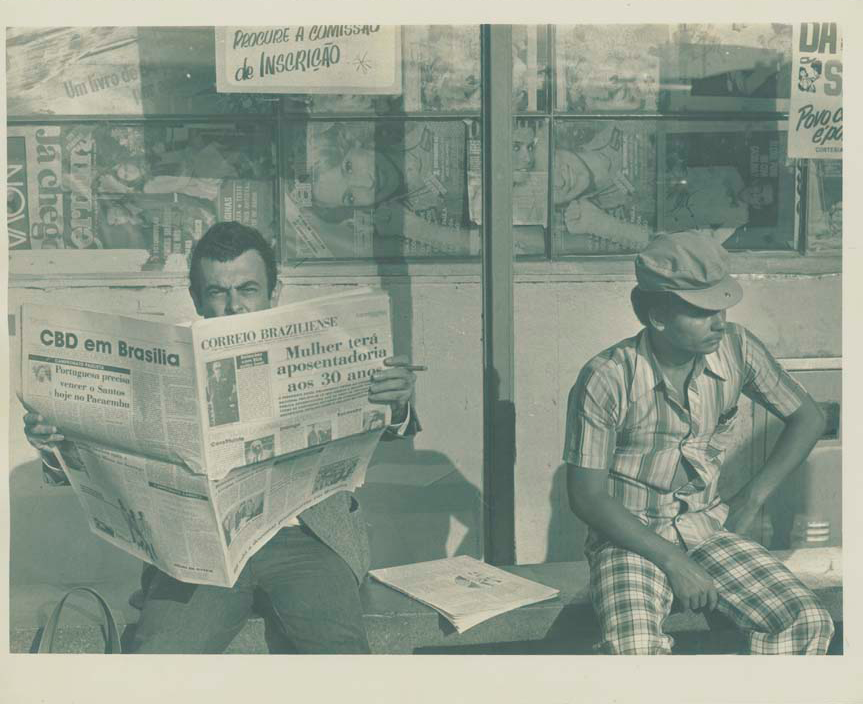
Metalworkers’ strike in the ABC region of São Paulo. The exhibition of Brazilian films becomes mandatory 133 days a year, along with the screening of a Brazilian short film as a complement to foreign films. The following films are released: “Anchieta, José do Brasil”, by Paulo César Saraceni; “A Lira do Delírio”, by Walter Lima Jr.; “A Batalha dos Guararapes”, by Paulo Thiago; and “Crônica de um Industrial”, by Luiz Rosemberg Filho. Embrafilme produces a series of films for television, including “Joana Angélica”, by Walter Lima Jr. The films are not shown on TV.
1979
On March 19th, Ava Pátria Yndia Yracema Gaitán Rocha, daughter of Glauber Rocha and Paula Gaitán, is born. Glauber publishes a supplement about the Passion of Christ in the Correio Braziliense newspaper on Good Friday. “Cabezas Cortadas” premieres in June in Rio de Janeiro, preceded by the short film “Di”. The painter’s daughter, Elizabeth Di Cavalcanti, prohibits the screening of the short film. Glauber begins contributing to various newspapers. In addition to Pasquim and Correio Braziliense, he writes regularly for Folha de S. Paulo and Jornal do Brasil. He attempts to obtain a scholarship in England for “a thesis on the dramaturgy of Oscar Wilde and possibly the staging of one of his plays and subsequent filming for TV, etc.” In July, he wrote to José Guilherme Merquior: “Besides the project about Oscar Wilde, there’s an embryonic screenplay about Marx and Engels… a film about the relationship between Economics and Philosophy and a production of Marlowe’s Faust… furthermore, my macumbas have taken me from the Umbanda terreiro to the sorcery of [William] Blake.” He was invited by Fernando Barbosa Lima to participate in the program “Abertura” on TV Tupi, where he interviewed intellectuals, politicians, and artists, with great repercussion. In an August letter, the publisher Ênio Silveira offered to publish Glauber’s unpublished books and mentioned the delivery of the novel “Jango,” with about four hundred pages, fictionalizing the life and ideas of President João Goulart. In September, Glauber protested not having been invited to the Brasília Film Festival. Accusing the French guest Jean Rocch (a filmmaker he admired) of being a “colonizer” and “agent of the Quai d’Orsay,” the scandal unfolds at the festival headquarters. In December, he writes to Alfredo Guevara: “I am 40 years old, a great age. I finally live with the love of my life, a Colombian poet, Paula Gaitán, and I have two children, in addition to Paloma, who is 18 years old and is an actress and theater and film director. I will be in Cannes. I intend to then film CARMEN in Spain – because Mozart Losey’s opera is crap and I want to spend some time in Seville.”
General João Batista Figueiredo becomes President of the Republic. End of AI-5. Repression of workers’ strikes. Miguel Arraes, Leonel Brizola, and Luís Carlos Prestes, among others, return from exile. Celso Amorim becomes director of Embrafilme. The Brazilian Film Cooperative emerges in Rio. The following films are released: “Bye Bye Brasil” by Cacá Diegues, “República dos Assassinos” by Miguel Faria Jr., and “Muito Prazer” by David Neves. Cinema reflects the political moment with films such as “Braços Cruzados” and “Máquinas Paradas” by Roberto Gervitz and Sérgio Tolledo Segall; “Greve!” by João Batista de Andrade; and “Greve de Março” by Renato Tapajós. Documentaries include: “Terra dos Índios” by Zelito Viana; “Mito e Metamorfose das Mães Nagô” by Juana Elbein; and “Em nome da Razão” by Helvécio Ratton. “Limite,” a classic by Mário Peixoto, is rediscovered and released. Jean-Claude Bernardet publishes *Cinema Brasileiro: Propostas para uma História*.
1980
Adamastor Bráulio Silva Rocha, Glauber Rocha’s father, dies on June 6th. Glauber participates in the Venice International Film Festival, where “The Age of the Earth” is screened on September 2nd. The film generates controversy and is poorly received by critics. Louis Malle receives the Venice Lion with Atlantic City, and Glauber accuses the filmmaker and the festival’s direction of being fascists, and in turn, is accused for his political positions in Brazil. The scandal in Venice leads to the withdrawal of “The Age of the Earth” from the Biarritz Iberian and Latin American Film Festival. In an interview with journalist Pedro del Picchia, in September/October, Glauber laments: “I left Venice vomiting. I spent two days in Florence with a high fever. I’m sick in Rome. Rome stinks, the city is full of thugs, it’s dirty. […] My relationship with cinema ended in Venice. I take this opportunity to say a definitive goodbye to Brazilian cultural life. You will not see me again. Never.” In December, Glauber traveled to Paris to attend a screening of his films at a Latin American film festival. Projects: In a letter to Celso Amorim, dated December 30th, from Paris, he wrote: “I am deciding with Claude-Antoine and other producers on the current script: ‘Napoleon’s Empire’, the first version of which I wrote in Brazil and I am working on a second version to be set in present-day Paris. This is the film I will make this year, although I don’t know how […] If I were to return to Brazil, I would also film ‘Napoleon’s Empire’ under the title ‘The Empire of Dom Pedro II’. But this panel that assembles Flaubert-Stendhal-Picasso-Hitchcock is a new and special discovery for France.” The film, “Napoleon’s Empire,” would be a loose adaptation of a book by Stendhal. Books: “There are about 5 or 6 books (novels, plays, poems, interviews, reviews of ‘arts’, ‘literature’ and ‘politics’) to be published, almost all more or less ready, whose originals are with my mother in Bahia. In addition, about 20 ‘sketched’ screenplays for film and TV. I was here with Aluísio Magalhães, an old friend of mine, and gave him 8 pages detailing all my films, books and projects. I expressed my desire to found a Communications Company in Paris (with a branch in Lisbon) and to begin my production.” Also in this letter, Glauber writes: “I live poorly and anguished by poverty and therefore ill: I spent 15 days vomiting with terrible pains and Aluísio Magalhães found me quite shaken.” He spends New Year’s in Vincennes with Parisian friends, at the home of the French film critic and friend Sylvie Pierre.
103 Brazilian feature films are produced. The films “Eu te Amo” (I Love You), by Arnaldo Jabor; “Pixote”, by Hector Babenco; “Gaijin”, by Tizuka Yamasaki; and “Os anos JK” (The JK Years), by Sílvio Tendler, are successful. The following films are released: “Cabaret Mineiro”, by Carlos Alberto Prates Correia; “O Homem que Virou Suco” (The Man Who Turned into Juice), by João Batista de Andrade; and “Brasília segundo Feldman” (Brasília According to Feldman), by Vladimir de Carvalho. A new strike by metalworkers in the ABC region of São Paulo occurs. “Am I or am I not the collective unconscious?” (Glauber Rocha).
1981
In January, Glauber organized a screening of “The Age of the Earth” for about fifty people at the Gaumont-Gare cinema in Lyon, Paris. In February, he traveled to Portugal, where he was received by the Portuguese filmmaker Manuel Carvalheiro, director of the documentary “Abecedário,” which includes a lengthy interview with Glauber recorded in Paris. He went to Sintra, where he met President João Batista Figueiredo. In April, the Portuguese Cinematheque screened a retrospective of his films, which was interrupted by a fire that destroyed copies of the films. In Sintra, Glauber received some friends but remained isolated with his family. From Sintra, in April, he writes to Cacá Diegues: “Paula and the boys are flourishing… Paloma and my mother are in Bahia… and I have two sons from Rio, Pedro and Daniel [Pedro Paulo de Araújo Rocha, Glauber’s son with Maria Aparecida de Araújo Braga, and Daniel Jardim Rocha, Glauber’s son with Marta Jardim, whose paternity was won in court]. […] I feel more or less at home, good bed, good food, good atmosphere, trans romanticism…”. In this letter, he refers to the play about João Goulart: “I wrote the play ‘Jango’, I left the originals with Luiz Carlos Maciel, it’s still incomplete, but it’s Theatre and not cinema”. In April, Glauber gives a long video testimony to the actor Patrick Bauchau, who was filming with Wim Wenders in Portugal, entitled “Sintra is a beautiful place to die”. He meets with Wim Wenders and Samuel Fuller. He gives an interview to the filmmaker Manuel Carvalheiro. With his health failing for several months, Glauber was diagnosed with viral pericarditis. In a letter to Celso Amorim in April, he wrote: “Everything is more or less okay here. I’m recovering from pericarditis and writing the screenplay for ‘Napoleon’s Empire’.” In a letter dated June 16th to American producer Tom Luddy, Glauber noted: “I’m writing a new screenplay: ‘The Fate of Humanity’. I’ll finish it on August 20th.” On August 6th, his condition worsened, and he was hospitalized near Lisbon due to bronchopulmonary complications. In extremely serious condition, he was brought back to Brazil on the night of the 20th, without medical supervision or intravenous fluids. He arrived in Rio de Janeiro on the 21st and received intravenous fluids in the infirmary at Galeão Airport. He was then taken to the Bambina Clinic in Botafogo. He died at 4:00 AM on August 22nd. Glauber’s wake was held at Parque Lage, the setting for “Terra em Transe,” amidst much emotion and exaltation. On August 27th, TV Globo aired “Glauber Rocha – Dead/Alive”, a Globo reporter program directed by Paulo Gil Soares. TV Bandeirantes aired “Glauber on TV” on August 29th, featuring excerpts from the Programa Abertura. On August 31st, “The Age of the Earth” was re-released in Rio de Janeiro at the Rian cinema and in Salvador at the Cine Glauber Rocha (formerly Guarany). In September, Luiz Carlos Maciel organized a show at Canecão in homage to Glauber, with the participation of actors and artists. Exhibitions and retrospectives of his work took place in Brazil (Salvador, São Paulo, etc.).(Brasília) and in several countries. In England, the National Film Institute continues a retrospective of his films. Other screenings take place in France (Institut National d’Études Cinematographiques) and the United States (American Film Institute). In September, Glauber is honored at the Figueira da Foz International Film Festival in Portugal and at the “Encuentro de Intelectuales por la Soberania de los Pueblos de Nuestra America” in Havana, Cuba. “História do Brasil” is screened for the first time in Brazil in December at the Cine Arte UFF in Niterói. In Brazil, “Revolução do Cinema Novo,” a collection of articles and interviews by Glauber, is published by Embrafilme and Alhambra. In Italy, IRAI (RAI’s publishing house) publishes “La Nascita Degli Dei,” the screenplay for Glauber’s “O Nascimento dos Deuses,” which was never filmed, with drawings by Paula Gaitán. Projects: In an unpublished text (Intellectual Production series, Glauber Time Archive) entitled “The Conquest of Eldorado” (undated, probably written in Sintra in 1981), Glauber reviews his entire life, in a kind of balance sheet and itinerary of activities and trips undertaken, where we find the following record:
Filmes a fazer:
“O destino da humanidade”, “O nascimento dos deuses”, “Os imortais”, “Infinito”, “Ilyada” e “Odisseya”.
Livros:
O GYGANTE ADAMAZTOR – romance JANGO – O PREZYDENTE QUE O POVO KOMEU -teatro e romance O PROFETA DO ATLÂNTICO – contos e novelas ANANECY – poemas JORNAL DA VYDA (entrevistas, política e literatura etc.) EXKORPYÃO (papéis avulsos sobrados de jornal vyda)ROTEYROS DO TERCEYRO MUNDO (de pátio a idade da terra) REVISÃO CRITICA DO CINEMA BRASILEI RO (Revisão, atualizar)O SEKULO DO KYNEMA (finalyzar)O NASCIMENTO DOS DEUSES (ok, reeditar com o filme) REVOLUÇÃO DO CINEMA NOVO (reeditar corrigido)-RIVERÃO SUSSUARANA (reeditar edição completa)BIOGRAFYA ÉPIKA E DIDÁTICA DE LEON H. (texto foto montagem]) kryação do parayzo (texto de Sintra) O destino da humanidade […]montagem de O GuaranyVILA-LOBOS – O ROMANTYZMO BRAZY LEYRO (ensaios e teatro) e a(FRYK)a [roteiro sobre escravos]
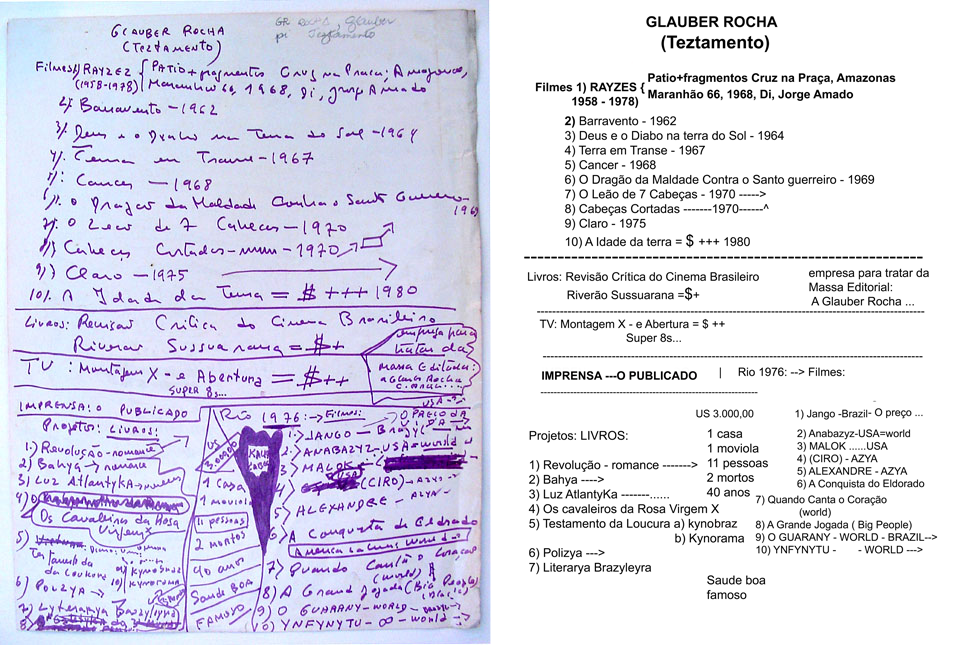
The explosion of a bomb at Rio Centro injures two soldiers involved in the attack against participants of the May 1st celebration. “They Don’t Wear Black Tie,” by Leon Hirszman, wins awards at the Venice Film Festival, Havana Film Festival, and other festivals.
The documentaries “Third Millennium,” by Jorge Bodansky and Wolf Gauer, and “Jânio at 24 Frames,” by Luiz Alberto Pereira (Gal), are released.
DIFUSÃO DA OBRA, post mortem:
1982
Raquel Gerber publishes *The Myth of Atlantic Civilization: Glauber Rocha, Cinema, Politics and the Aesthetics of the Unconscious* by Editora Vozes. Pedro del Picchia and Virgínia Murano publish *Glauber, the Lion of Venice*, by Editora Escrita; an interview with Glauber about the controversial participation in *The Age of the Earth* is shown during the Berlin Film Festival. At the International Short Film and Documentary Festival in Lille, France, *Pátio*, *Amazonas, Amazonas*, *Maranhão 66*, *Di*, and *History of Brazil* are screened. In March, the Glauber Rocha Cycle takes place in Florianópolis. In August, the *Tempo Glauber* exhibition takes place in Salvador. A retrospective of his films is held at the São Paulo Cultural Center. In Rio, the *Glauber Presente* exhibition is held at the Jacobina School, organized by students from the Federal Fluminense University and RioArte. On August 22nd, TV Bandeirantes airs a special about Glauber directed by Paula Gaitán. On August 23rd, the short film “Abecedário,” about Glauber Rocha and directed by the Portuguese filmmaker Manuel Carvalheiro, will be screened at the Cinema Veneza. Also on the 23rd, the TV Record program “Noites Cariocas” will host a roundtable discussion about the filmmaker. In September, a retrospective of his films will take place at the Center for Cinematographic Studies in Belo Horizonte, and Glauber Rocha will be honored by the Tuca (Teatro da Universidade Católica) in São Paulo.
1983
During the Rio Carnival, Glauber Rocha is honored by the Lins Imperial Samba School with the samba-enredo “Glauber Presente” (Glauber Present). The book *O século do cinema* (The Century of Cinema), a collection of Glauber Rocha’s articles on American cinema, neorealism, and the Nouvelle Vague, is published by Editora Alhambra. Ismail Xavier publishes *Sertão Mar: Glauber Rocha e a Estética da Fome* (Sertão Sea: Glauber Rocha and the Aesthetics of Hunger), by Editora Brasiliense. On August 28th, TV Bandeirantes broadcasts the film “Di”. In Recife, the exhibition *Passem Glauber* (Pass Glauber) takes place at the Teatro do Parque. In December, the collection of Glauber Rocha’s work, gathered by his mother, Lúcia Rocha, gains a dedicated room at the Museum of Image and Sound in Rio de Janeiro. The collection is named *Tempo Glauber* (Glauber Time).
1984
“Cancer” premiered on August 22nd in Rio de Janeiro, at Santa Úrsula University, in a special session promoted by Embrafilme and Glauber’s friends. Randal Johnson published Cinema Novo X 5, a study on five directors of Cinema Novo, including Glauber.
1985
“Roteiros do Terceyro Mundo” (Third World Screenplays), a book conceived by Glauber Rocha containing the screenplays and dialogues of his feature films, is published by Embrafilme/Alhambra, organized by filmmaker Orlando Senna. In March, the Glauber by Glauber exhibition, the first complete retrospective of his films, will take place at the São Luiz 1 cinema in Rio de Janeiro, having been shown in eleven Brazilian states.
1986
The Venice Film Festival pays special tribute to Glauber Rocha with a complete retrospective of his films. In Italy, critic Lino Miccichè organizes the books *Scritti sul cinema* and *Rocha: saggi & in vective sul Nuovo Cinema*. In August, the exhibition *Tempo Glauber*, promoted by SESC, opens in São Paulo, touring twenty states and small cities, including Rio Branco, Acre, where it arrived in October 1989. Sidney Rezende’s *O ideário de Glauber Rocha* is published by Editora Philobiblion, containing quotations from interviews and articles by Glauber in the press. Roque Araújo, a collaborator of Glauber, creates “No tempo de Glauber,” a montage of sequences (“leftovers”) not included in *A Idade da Terra*, with excerpts from Glauber’s controversial filming in Salvador.
1987
French critic Sylvie Pierre publishes Glauber Rocha’s work in France, in the Auteurs collection of Cahiers du Cinéma. “Barravento,” Glauber’s debut novel by José Gatti, is published by the University of Santa Catarina Press.
1989
The book “Poemas Eskolhydos” by Glauber Rocha, a selection of 28 poems written by Glauber between 1965 and 1981, is organized by Editora Alhambra. The book is not commercially released. “O Homem dos Cabelos Azuis” (The Man with Blue Hair), a documentary by Sylvie Pierre and Georges Ullman about Glauber’s relationship with European critics, is produced. On March 22nd, Tempo Glauber, an archive with approximately 60,000 documents including films, correspondence, writings, publications, poems, drawings, and interviews by Glauber, directed by Lúcia Rocha, is inaugurated on Rua Sorocaba, in Botafogo.
1991
In October, in Los Angeles, the new copy of “Terra em Transe,” made at the initiative of American filmmaker Martin Scorsese, will be shown for the first time. “Que viva Glauber,” a documentary by Aurélio Michiles, will be shown on October 27th on TV Educativa.
1994
In March and April, the exhibition “Glauber Rocha, a Lion at Noon” was held at the Banco do Brasil Cultural Center in Rio de Janeiro, featuring lectures, films, videos, and an exhibition of Glauber’s drawings, as well as photos and documents from the period. On September 26, Glauber Rocha was awarded an honorary doctorate by the Federal University of Bahia.
1996
In July, the Glauber Rocha Archive launches its website. That same month, the Federal University of Southwest Bahia hosts the event “Glauber Rocha and the Century of Cinema” in Vitória da Conquista, Glauber’s birthplace, and awards Glauber an honorary doctorate. In Rio, Lúcia Rocha launches the Association of Friends of the Glauber Rocha Archive. Luiz Carlos Maciel stages Glauber’s play “Jango.” The book “Anabasis Glauber: From the Age of Men to the Age of Gods,” by Martim Cezar Feijó, is published by Anabasis and the Álvares Penteado Foundation. The Glauber Rocha Archive receives an invitation from the Bahia government to relocate to Salvador. After three years of research, Glauber’s correspondence is selected and organized for publication. This chronology is revisited by Paloma Rocha and published in Ivana Bentes’ book “Letters to the World.”